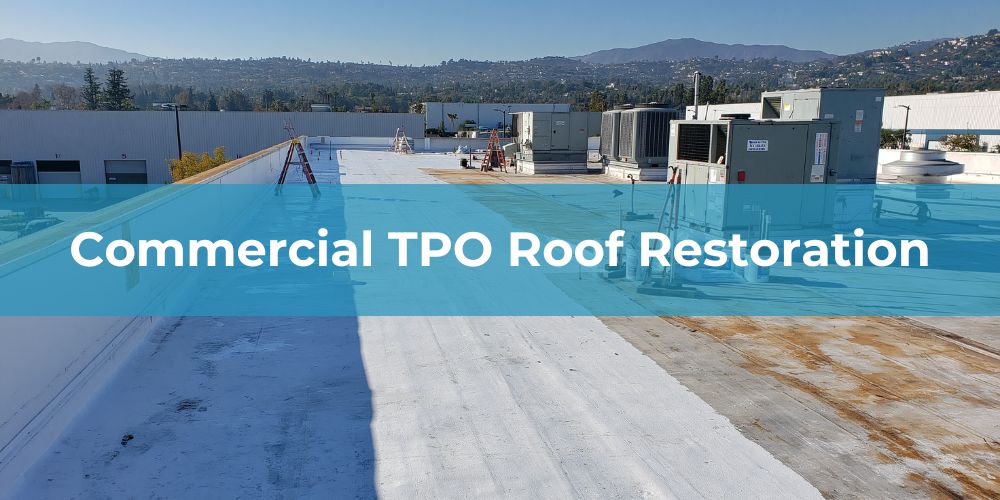
TPO Roofing Los Angeles provides commercial TPO roof restoration for warehouses, retail centres, offices, industrial facilities, apartment buildings, and other Los Angeles properties with ageing but retainable thermoplastic polyolefin roofing systems. Commercial TPO roof restoration is the coordinated repair, reinforcement, and surface renewal of an existing TPO assembly where deterioration affects multiple roof areas but enough of the membrane, insulation, attachment, and structural deck remains serviceable to retain. The objective is to restore waterproofing continuity and renew protection across the existing roof without removing sound components or automatically replacing the complete assembly. Investigative repairs and restoration-system installation are carried out by a California contractor holding an active C-39 roofing classification.
TPO roof restoration is broader than commercial TPO roof coating. A coating is the liquid-applied protective membrane incorporated into some restoration specifications; restoration is the complete intervention required to make the retained roof suitable for renewed service. This may include investigation, localised removal of failed materials, membrane and detail repair, reinforcement, surface preparation, adhesion verification, and installation of the selected renewal system. A restoration membrane should therefore be applied only after defects that could compromise the retained assembly have been identified and corrected.
Restoration is suitable only where investigation confirms that the existing roof provides a sufficiently dry, stable, repairable, and compatible base for continued service. Localised wet insulation, failed membrane, defective flashings, incompatible previous repairs, attachment defects, or drainage problems may be corrected within the restoration scope. Restoration is not appropriate where moisture is widespread, attachment is unstable across substantial areas, the membrane can no longer be repaired reliably, structural decking has materially deteriorated, or dependable drainage requires reconstruction of the roof profile.
Los Angeles conditions influence which parts of a retainable TPO roof require repair, reinforcement, preparation, or surface renewal. The relevant exposure mechanisms are:
- Solar heat and repeated thermal movement: prolonged ultraviolet exposure and elevated roof temperatures across the Los Angeles Basin, particularly in hotter valley and inland locations, accelerate membrane weathering and repeated expansion and contraction → flexibility decreases and stress concentrates at seams, flashings, penetrations, curbs, and restrained interfaces → restoration may require continuous surface renewal together with targeted repair and reinforcement of thermally stressed details.
- Variation between inland and coastal exposure: roofs closer to the coast can experience a different temperature and weathering pattern from hotter inland properties → membrane ageing, movement, contamination, and detail performance may develop at different rates across Los Angeles → restoration scope must be established from the condition of the individual roof rather than transferred from another location or building.
- Santa Ana wind exposure: concentrated wind pressure acts on perimeters, terminations, flashings, membrane attachment, insulation, and rooftop components → movement or lifting can weaken interfaces that would otherwise remain beneath the restoration system → attachment and perimeter stability must be verified and corrected before continuous surface renewal is installed.
- Airborne dust, smoke, soot, and ash: dry weather, regional wildfire events, and wind can deposit fine contamination across field membrane, seams, repairs, drains, and equipment zones → residues can obscure defects and interfere with welding, priming, reinforcement, and liquid-applied adhesion → affected surfaces require appropriate cleaning and adhesion verification before restoration materials are applied.
- Long dry periods followed by concentrated rainfall: leaves, dust, sediment, and rooftop debris can accumulate before rainfall directs water rapidly toward outlets and low points → restricted drainage prolongs ponding and exposes defects around seams, penetrations, previous repairs, drains, and scuppers → obstructions and correctable drainage defects must be resolved before the retained roof is renewed.
- Wind-driven rainfall at adjoining interfaces: rain striking parapets, walls, curbs, penetrations, and edge details can expose water-entry paths that are not evident during lighter vertical rainfall → leakage may originate outside the visibly weathered field membrane → adjoining interfaces must be investigated and reconstructed where necessary before restoration is completed.
- Rooftop access and equipment servicing: repeated movement around HVAC, communications, and other building-service equipment can puncture membrane, compress insulation, displace protection, and create repeated repair zones → deterioration persists where traffic and equipment interfaces remain uncontrolled → restoration can incorporate repaired details, reinforced service areas, and protected access routes where required.
These conditions do not establish restoration suitability by themselves. They determine where deterioration is likely to occur, which interfaces require closer investigation, and what correction or preparation may be necessary once the roof has otherwise been confirmed as retainable. Commercial TPO roof restoration is therefore selected when deterioration has progressed beyond routine maintenance or isolated repair but has not compromised enough of the assembly to justify complete replacement. TPO Roofing Los Angeles evaluates membrane repairability, moisture distribution, attachment and deck condition, drainage, previous treatments, rooftop interfaces, and site-specific exposure to determine what can remain, what must be repaired or reconstructed, and whether the retained roof can support a continuous restoration system.
What Confirms That a Commercial TPO Roof Can Be Restored in Los Angeles?
A commercial TPO roof can be restored when investigation confirms that enough of the existing assembly remains dry, securely attached, structurally stable, repairable, and compatible with the proposed restoration system. Surface appearance alone is not sufficient. TPO Roofing Los Angeles evaluates the retained membrane and supporting roof build-up to determine whether defective materials can be removed locally while the remaining assembly continues to provide a dependable base for coordinated repair, reinforcement, and surface renewal.
The assessment must distinguish a genuinely restorable roof from one that merely appears suitable for coating. Restoration can retain substantial areas of the existing assembly only where active defects, moisture damage, unstable components, incompatible materials, and drainage problems can be identified and corrected within a coherent restoration scope. Suitability is confirmed through eight connected findings:
- Existing construction and material compatibility can be established: the membrane type, installation method, insulation and cover-board build-up, attachment system, deck construction, previous coatings, repair materials, leak history, and rooftop alterations are identified. Existing sealants, mastics, coatings, patches, or other materials must be removable, isolatable, or compatible with the proposed welding, priming, reinforcement, and surface-renewal system.
- The retained TPO membrane remains repairable: representative field areas, seams, flashings, and previous repairs are examined for weathering, brittleness, contamination, shrinkage, surface damage, and loss of weldability. Restoration remains viable where defective membrane can be removed or reinforced and the surrounding TPO can form a reliable connection with compatible repair materials.
- Moisture damage is limited and removable: leak evidence, moisture surveys, and selective investigative openings are used where necessary to establish whether insulation, cover board, attachment components, or decking are affected. Localised wet materials may be removed to a verified dry boundary, while widespread or interconnected moisture indicates that restoration is no longer a dependable strategy.
- Attachment and structural support remain serviceable: membrane attachment, insulation securement, fasteners, adhesive bonds, deck connections, and accessible structural substrate are checked for movement, uplift, displacement, corrosion, decay, cracking, deformation, or loss of strength. Localised defects may be corrected, but restoration cannot compensate for a roof build-up or deck that has lost reliable structural support.
- Seams, flashings, and adjoining details can be reconstructed: welded laps, penetrations, equipment curbs, walls, perimeter edges, terminations, drains, scuppers, expansion details, and other interfaces are assessed to determine whether failed components can be rebuilt and reconnected to serviceable surrounding materials. Restoration remains appropriate only where these corrections can be completed without reconstructing substantial sections of the roof.
- Drainage defects can be corrected within the retained build-up: drains, scuppers, sumps, low points, roof falls, crickets, and water-flow routes are checked for obstruction, displacement, and persistent ponding. Debris accumulation common during extended dry periods in Los Angeles can be cleared and local defects corrected, but restoration should not be used where dependable drainage requires reconstruction of the roof profile.
- The retained surface can support reliable restoration adhesion: representative membrane areas are cleaned using the proposed preparation method and tested for compatibility with primers, reinforcement materials, and liquid-applied restoration products. Testing should include weathered, contaminated, previously repaired, and heavily serviced areas because preparation and adhesion performance can vary across the same roof.
- A continuous restoration boundary can be established: the completed scope must extend through connected defects and terminate at sound, dry, stable, and compatible roofing materials. Local membrane removal, wet-insulation replacement, flashing reconstruction, attachment correction, drainage work, reinforcement, and preparation must combine into one integrated restoration area rather than a collection of disconnected surface treatments.
Los Angeles exposure is incorporated into these findings rather than treated as a separate reason to restore a roof. Solar heat and thermal movement affect membrane repairability and detailing, Santa Ana winds influence attachment and perimeter assessment, airborne dust or wildfire residue affects preparation and adhesion, and rooftop servicing or concentrated rainfall can expose traffic damage, drainage defects, or concealed moisture. No single finding confirms restoration suitability by itself. TPO Roofing Los Angeles confirms restoration only where moisture remains controllable, retained materials are repairable and stable, defects can be reconstructed locally, drainage can be corrected, and the selected restoration system can form continuous protection across the retained assembly. Where those conditions cannot be achieved, the roof requires partial reconstruction or complete TPO replacement instead.
Have a question about a TPO roofing project?
How Is a Commercial TPO Roof Restored in Los Angeles?
A commercial TPO roof is restored after investigation confirms that the retained assembly is sufficiently dry, stable, repairable, and compatible with the selected restoration system. TPO Roofing Los Angeles coordinates localised reconstruction, membrane and detail repair, surface preparation, reinforcement, liquid-applied renewal, and completion verification as one connected process. The objective is to correct existing defects before renewing protection across the retained roof rather than applying a surface treatment over unresolved failure.
The restoration is completed through six connected stages:
- Defect removal and local reconstruction: incompatible patches, failed sealants, deteriorated membrane, localised wet insulation, damaged cover board, unstable attachment, and other materials identified within the restoration scope are removed where necessary. Affected areas are reconstructed to sound, dry, stable, and compatible roofing materials before surface renewal begins.
- Membrane and detail repair: open seams, punctures, splits, flashings, penetrations, equipment curbs, perimeter details, terminations, drains, scuppers, and adjoining interfaces are repaired or rebuilt where required. Each correction must reconnect reliably with the retained TPO so active water-entry paths and defective interfaces are resolved before they are incorporated into the restoration system.
- Cleaning and surface preparation: the retained membrane is cleaned to remove dust, ash, oils, rooftop discharge, loose material, degraded surface contamination, and residues capable of interfering with adhesion. Weathered areas, previous repairs, traffic zones, and other identified surfaces are prepared according to the selected system so the substrate condition achieved during testing is reproduced across the work area.
- Primer and detail reinforcement: compatible primer is applied where required, followed by reinforcement of seams, repairs, penetrations, curbs, transitions, perimeters, movement-sensitive interfaces, and other vulnerable details included within the specification. These treatments strengthen localised interfaces before the field restoration membrane is applied continuously across the retained roof.
- Field restoration membrane application: the specified liquid-applied restoration material is installed across the prepared TPO at the required coverage and build. Application is sequenced so repaired details, reinforced interfaces, and field areas connect into one continuous protective layer, with work controlled around drains, equipment, perimeters, and other interruptions to maintain waterproofing continuity.
- Curing and completion verification: the completed restoration is checked for continuity, adhesion, coverage, detailing, drainage condition, and integration with repaired roof interfaces. Where appropriate, wet-film or dry-film measurements, adhesion checks, visual inspection, or other system-specific verification are used to confirm that the required application has been achieved before the roof is returned to service.
Each stage resolves a different condition within the retained assembly. Local reconstruction removes contained subsurface failure, membrane repair restores existing waterproofing defects, preparation creates a reliable bonding surface, reinforcement strengthens vulnerable interfaces, and the field restoration layer renews protection across the wider roof area. Once TPO Roofing Los Angeles confirms that the repaired details are integrated with the retained membrane, the restoration system has formed continuous protection, and drainage and rooftop interfaces remain serviceable, the restored roof can return to normal operation and future condition monitoring.
Have a question about a TPO roofing project?
When Should a Los Angeles Business Consider Commercial TPO Roof Restoration?
A Los Angeles business should consider commercial TPO roof restoration when deterioration affects multiple areas of the roof but the existing assembly remains broadly dry, securely attached, structurally serviceable, and capable of being retained. Restoration assessment is appropriate where recurring seam or flashing defects, widespread membrane weathering, repeated localised repairs, surface contamination, drainage-related deterioration, or vulnerable rooftop interfaces indicate that maintenance and isolated repair are no longer providing a durable solution. Contact TPO Roofing Los Angeles before these conditions progress into widespread moisture damage, unstable attachment, structural deterioration, or extensive reconstruction requirements. Assessment can determine whether the roof remains suitable for coordinated repair and surface renewal, whether a more limited intervention is sufficient, or whether deterioration has advanced beyond restoration and requires partial reconstruction or complete TPO roof replacement.