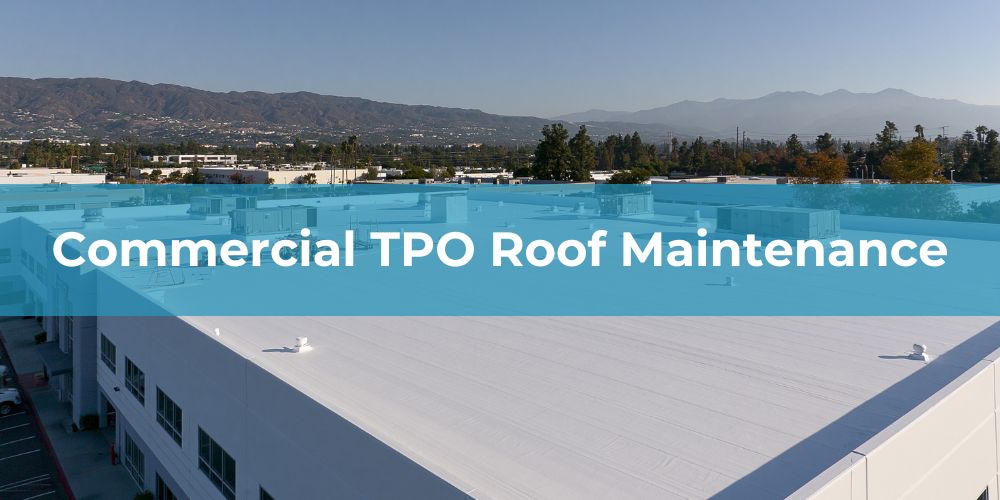
TPO Roofing Los Angeles provides commercial TPO roof maintenance for warehouses, retail centres, offices, industrial facilities, apartment buildings, and other Los Angeles properties with flat or low-slope thermoplastic polyolefin roofing systems. Commercial TPO roof maintenance is the planned inspection, cleaning, localised defect correction, and condition monitoring of an existing TPO membrane. The service preserves waterproofing continuity, maintains clear drainage routes, and identifies developing damage before moisture reaches the insulation, structural deck, or occupied areas below. Repairs arising from the maintenance assessment are carried out by a California roofing contractor holding an active C-39 classification. A commercial TPO maintenance programme addresses the field membrane and the details where water entry, movement, impact damage, or drainage restriction is most likely to develop. The work may include examining heat-welded seams, flashings, penetrations, equipment curbs, perimeter edges, terminations, drains, scuppers, previous repairs, access routes, and areas surrounding rooftop machinery. Leaves, sediment, dust, and loose debris are removed; repairable punctures, seam openings, damaged flashings, and failed compatible terminations are corrected; and identified defects are recorded so changes in roof condition can be compared across later inspections.
Maintenance preserves roofing components that remain serviceable; it does not conceal or reverse system-wide failure. It cannot replace saturated insulation, stabilise damaged decking, restore unstable attachment, create new drainage falls, or correct extensive membrane deterioration through repeated local patching. Where investigation identifies distributed moisture, widespread seam separation, structural damage, or recurring defects caused by a broader assembly failure, the roof requires a separate assessment for restoration, partial reconstruction, or replacement.
The maintenance requirements for commercial TPO roofs in Los Angeles are determined by the environmental and operational conditions acting on specific parts of the roofing system:
- Prolonged ultraviolet exposure and elevated rooftop temperatures → accelerate surface weathering and reduce flexibility in ageing membrane areas → cracking, brittleness, and stress-related deterioration become more likely → scheduled inspection identifies affected locations while corrective work can remain localised.
- Repeated daytime heating and overnight cooling → produce expansion and contraction across seams, flashings, penetrations, curbs, and restrained perimeter details → movement concentrates stress at welded and mechanically fixed interfaces → maintenance detects lifting, separation, and fatigue before a continuous water-entry path develops.
- Airborne dust, leaves, and rooftop debris → collect around drains, scuppers, outlets, gutters, and low points → restricted flow extends the duration of ponding after rainfall → routine clearance restores unobstructed drainage and reduces the time that seams, repairs, and membrane transitions remain submerged.
- Foot traffic and rooftop equipment servicing → expose access routes and mechanical zones to punctures, cuts, dropped tools, compression, and displaced protection → minor damage enlarges under repeated use → targeted inspection, membrane repair, and access control prevent deterioration from spreading into adjoining roof areas.
- Wind-driven or concentrated rainfall → tests edges, penetrations, flashings, seams, wall junctions, and adjoining interfaces that may remain dry during lighter rainfall → concealed weaknesses admit moisture beneath the visible membrane → maintenance prioritises these entry points before water migrates into insulation or decking.
- Ageing sealants, accessories, and previous repair materials → create interfaces with different adhesion, movement, and weathering characteristics → incompatible or deteriorated components separate from the original TPO membrane → defective materials are removed and replaced before the same location develops recurring leakage.
The initiating condition determines the maintenance response. Debris-related ponding requires drainage clearance; traffic damage requires local membrane repair and protection of access routes; movement at seams or flashings requires correction of the affected detail; and suspected subsurface moisture requires investigation rather than another surface patch.
Commercial TPO roof maintenance is therefore planned according to documented roof risk rather than membrane age or a universal service interval. TPO Roofing Los Angeles evaluates membrane condition, seam integrity, flashing performance, drainage exposure, previous leak history, rooftop equipment density, access frequency, debris accumulation, repair history, and the operational consequences of water entry. This assessment identifies what requires immediate correction, which areas should be monitored, how frequently the roof should be inspected, and when deterioration has progressed beyond routine maintenance.
How Is a Commercial TPO Roof Maintenance Programme Planned in Los Angeles?
A commercial TPO roof maintenance programme in Los Angeles is planned by converting the roof’s condition, exposure, use, and failure consequences into defined inspection areas, corrective priorities, monitoring requirements, and service intervals. The programme should reflect how the individual roof behaves rather than applying the same annual checklist to every property. A heavily serviced roof in the San Fernando Valley may require different attention from a lightly accessed roof closer to the coast because membrane temperatures, particulate accumulation, rooftop traffic, drainage exposure, and thermal movement vary across Los Angeles.
Planning begins with a baseline assessment that records the condition of the field membrane, heat-welded seams, flashings, penetrations, equipment curbs, perimeter details, terminations, drains, scuppers, previous repairs, access routes, and known leak locations. This establishes the roof’s starting condition and creates a reference against which later changes can be measured. Defects are then classified according to the action they require:
- Immediate corrective work: open seams, punctures, displaced flashings, failed terminations, blocked outlets, and other defects capable of admitting water are prioritised before routine monitoring begins.
- Further investigation: internal staining, suspected wet insulation, recurring leaks, unstable attachment, unexplained membrane movement, and concealed deterioration require additional testing before the condition can be assigned to routine maintenance.
- Planned maintenance: debris accumulation, surface contamination, ageing compatible sealants, minor localised wear, and serviceable details approaching deterioration are scheduled for cleaning, treatment, or limited correction.
- Condition monitoring: stable weathering, previously repaired areas, minor movement, and non-progressive surface changes are documented and re-examined during later visits to determine whether deterioration is advancing.
- Escalation beyond maintenance: distributed moisture, widespread seam failure, structural deck damage, unstable attachment, extensive loss of membrane serviceability, or repeated failure across multiple roof zones is referred for restoration, partial reconstruction, or replacement assessment.
This classification prevents urgent waterproofing defects from being treated as routine observations and prevents harmless surface ageing from triggering unnecessary repair. It also establishes a clear boundary between maintenance activity and conditions requiring diagnostic testing or broader roofing intervention.
The roof is then divided into risk zones according to the likelihood and consequence of failure. High-priority zones commonly include drains and low points, penetrations, equipment curbs, perimeter edges, wall junctions, previous leak locations, earlier repairs, repeated access routes, and areas beneath or beside rooftop machinery. Lower-risk field areas remain part of the inspection, but they do not receive the same level of scrutiny unless weathering, attachment, or surface damage indicates a developing problem.
Los Angeles exposure is incorporated into the risk map because different mechanisms affect different parts of the roof:
- High solar exposure and hotter inland conditions increase attention to ageing seams, rigid details, repaired interfaces, and membrane areas showing reduced flexibility.
- Santa Ana wind exposure increases inspection priority at perimeters, terminations, loose rooftop components, membrane attachment points, and windward interfaces.
- Extended dry periods increase the likelihood of dust, leaves, ash, and sediment collecting around outlets before concentrated rainfall occurs.
- Frequent HVAC and equipment servicing increases the inspection frequency of access routes, mechanical zones, curbs, supports, penetrations, and displaced walkway protection.
- Moisture-sensitive occupancy increases the consequence of even a small defect where the roof protects electrical systems, stored goods, residential units, production areas, or finished interiors.
These factors determine the inspection interval. A fixed yearly schedule may be sufficient for a stable, lightly accessed roof with clear drainage and no leak history, but it may be inadequate where the membrane is ageing, contractors regularly access rooftop equipment, debris repeatedly blocks outlets, or previous defects have returned. Additional inspections may also be scheduled after severe wind, concentrated rainfall, rooftop construction, equipment replacement, solar installation, or other activity capable of damaging the membrane or altering drainage. Each maintenance visit is assigned a defined scope rather than a general instruction to inspect the roof. The plan identifies which zones require close examination, which drains and outlets must be cleared, which previous repairs must be checked, which documented defects require comparison, and which corrective tasks must be completed. This improves consistency between visits and ensures that known risk areas are not overlooked when personnel or site conditions change.
Condition records should identify the location, type, severity, likely cause, repair status, and progression of each defect. Photographs, roof plans, moisture findings, repair dates, rainfall history, and notes on rooftop activity allow later inspections to determine whether a condition is stable, recurring, or spreading. A single observation shows what the roof looks like at one moment; a maintained condition history shows how the roofing system is performing over time. The completed programme establishes inspection frequency, risk zones, corrective priorities, documentation requirements, and escalation thresholds for the individual Los Angeles property. It also defines the work to be completed during each maintenance visit, including membrane inspection, drainage clearance, localised defect correction, previous-repair review, traffic-area assessment, and condition recording.
Have a question about a TPO roofing project?
What Happens During a Commercial TPO Roof Maintenance Visit in Los Angeles?
A commercial TPO roof maintenance visit in Los Angeles applies the existing maintenance programme to the current condition of the roof. TPO Roofing Los Angeles inspects the defined risk zones, clears drainage routes, identifies changes since the previous visit, completes suitable localised corrective work, and records defects that require monitoring or further investigation. The purpose is not simply to confirm that the roof has been inspected. Each visit must determine what has changed, what can be corrected within maintenance, and whether any condition has progressed beyond the maintenance threshold.
The visit follows six connected stages so inspection findings lead directly to the appropriate maintenance response:
- Recent-condition and roof-access review: known leaks, recent rainfall, wind events, rooftop construction, HVAC servicing, equipment replacement, solar work, and other activity since the previous inspection are reviewed before the roof is examined. Access routes and working areas are then checked for new damage, displaced protection, loose materials, or changes that could affect the membrane. This establishes where recent events may have altered the condition recorded during the previous visit.
- Drainage inspection and clearance: drains, scuppers, gutters, outlets, sumps, low points, and adjoining membrane areas are examined for leaves, dust, ash, sediment, loose debris, displaced components, and other restrictions to water flow. Removable obstructions are cleared, while persistent ponding or defective drainage components are recorded for correction where maintenance alone cannot restore proper drainage.
- Membrane and detail inspection: the field membrane, heat-welded seams, flashings, penetrations, equipment curbs, perimeters, wall junctions, terminations, previous repairs, traffic routes, and identified risk zones are checked for punctures, separation, lifting, splits, wear, failed materials, or movement. Particular attention is given to locations already documented as vulnerable so stable conditions can be distinguished from defects that are recurring or progressing.
- Localised corrective maintenance: defects suitable for maintenance are corrected before they develop into larger waterproofing failures. This may include repairing isolated punctures, closing repairable seam openings, replacing compatible failed sealants or termination materials, correcting minor flashing defects, securing localised loose details, and restoring protection around traffic or service areas. Corrective work remains limited to defects where the surrounding TPO assembly is still sound and serviceable.
- Rooftop activity and protection assessment: areas around HVAC units, supports, curbs, service routes, access points, and other regularly used roof zones are examined for damage caused by foot traffic, tools, equipment servicing, displaced walkway protection, or new penetrations. Where repeated activity is contributing to membrane wear, the maintenance response may include restoring protection, changing access controls, or identifying a requirement for more durable traffic measures rather than repeatedly repairing the same location.
- Condition recording and escalation: completed maintenance, unresolved defects, recurring conditions, moisture concerns, and changes from previous inspections are recorded against their roof locations. Defects that cannot be safely or reliably resolved through routine maintenance are referred for further investigation. Suspected wet insulation, unstable attachment, widespread seam deterioration, structural damage, recurring leakage, or deterioration extending across multiple roof zones requires assessment for repair, restoration, partial reconstruction, or replacement rather than continued local patching.
Each stage produces a different maintenance outcome. Drainage clearance removes avoidable water-flow restrictions, inspection identifies developing failure, local repairs restore serviceable defects, traffic controls reduce repeated damage, and condition records show whether the roof is remaining stable or deteriorating between visits. The completed visit therefore updates the maintenance programme with current evidence from the roof. TPO Roofing Los Angeles can then determine which areas require continued monitoring, which defects need scheduled corrective work, whether inspection frequency should change, and whether any condition has moved beyond routine maintenance into a broader roofing intervention.
Have a question about a TPO roofing project?
How Are Commercial TPO Roof Maintenance Findings Used to Manage the Roof Over Time?
Commercial TPO roof maintenance findings are used to track how the roofing system changes between inspections and to adjust future maintenance according to documented performance. TPO Roofing Los Angeles compares current observations with previous condition records to determine whether defects are stable, recurring, or spreading; whether completed repairs remain effective; and whether particular roof zones are developing a higher probability or consequence of failure. This converts individual maintenance visits into a continuing record of roof performance rather than a series of isolated inspections.
The accumulated findings support five connected roof-management decisions:
- Condition progression assessment: current membrane weathering, seam movement, flashing condition, drainage performance, traffic damage, and other documented defects are compared with earlier records from the same locations. A condition that remains unchanged may continue to be monitored, while increasing separation, wear, movement, ponding, or deterioration indicates that the affected area requires greater attention or corrective action.
- Recurring-defect identification: repeated problems at the same seam, penetration, curb, perimeter, drain, repair location, or traffic zone are treated differently from isolated damage. Recurrence can indicate continuing thermal movement, concentrated foot traffic, drainage exposure, incompatible materials, unstable attachment, or another underlying mechanism that routine patching has not resolved. Tracking the location and frequency of defects allows TPO Roofing Los Angeles to distinguish repeated symptoms from one-off maintenance issues.
- Previous-repair performance monitoring: earlier seam repairs, membrane patches, flashing corrections, termination work, sealant replacement, and traffic-protection measures are re-examined during later visits. Repairs that remain secure and unchanged demonstrate stable local performance, while repeated separation, cracking, lifting, or leakage indicates that the repair method, surrounding membrane, or underlying roof condition requires further investigation.
- Risk priority and maintenance-plan adjustment: the roof's risk map is updated as new evidence becomes available. Locations showing repeated defects, increasing weathering, persistent debris accumulation, drainage problems, frequent contractor access, or growing leak consequences can be assigned greater inspection priority, while stable areas may continue under the existing level of monitoring. The maintenance programme therefore changes with the roof rather than remaining fixed to the assumptions made during the original assessment.
- Escalation beyond routine maintenance: the condition history provides evidence for determining when continued local maintenance is no longer the appropriate response. Increasing repair frequency, defects spreading across multiple roof zones, recurring leakage, concealed moisture, unstable attachment, deteriorated insulation or substrate materials, or failure of previously repaired details can justify further diagnostic investigation and assessment for targeted repair, restoration, partial reconstruction, or replacement.
The value of the maintenance record is therefore not the quantity of inspections completed, but the ability to identify change. A single defect can often be corrected locally; repeated deterioration at the same location identifies a pattern; deterioration appearing across several roof zones can indicate a broader change in the performance of the roofing assembly.
By maintaining this condition history, TPO Roofing Los Angeles can refine inspection priorities, evaluate whether previous corrective work is holding, identify emerging failure patterns, and determine whether the roof remains within the maintenance threshold. These findings also provide the evidence needed to decide when the next planned or event-driven maintenance visit should take place.
Have a question about a TPO roofing project?
When Should a Los Angeles Business Schedule Commercial TPO Roof Maintenance?
A Los Angeles business should schedule commercial TPO roof maintenance when the planned inspection interval is reached, new leaks or visible defects appear, drainage performance deteriorates, or severe weather and rooftop work may have affected the membrane. Earlier assessment is also appropriate where seams, flashings, penetrations, previous repairs, or other roof details repeatedly require attention. Contact TPO Roofing Los Angeles when a commercial TPO roof is due for planned maintenance or develops conditions that could compromise waterproofing. Early assessment can determine whether the roof requires routine maintenance, localised repair, further investigation, or escalation to restoration or replacement before deterioration spreads through the roofing assembly.