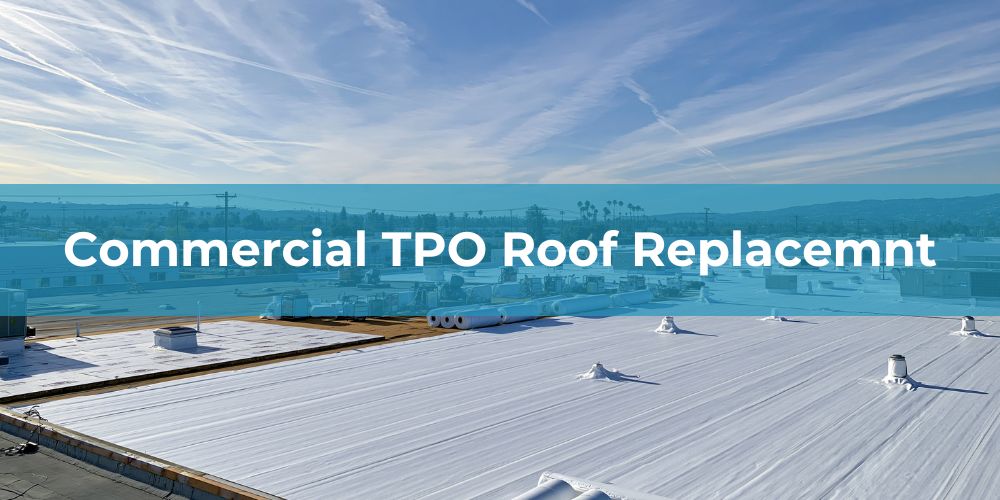
TPO Roofing Los Angeles provides commercial TPO roof replacement for warehouses, retail centres, offices, industrial facilities, apartment buildings, and other Los Angeles properties with flat or low-slope thermoplastic polyolefin roofing systems. Commercial TPO roof replacement is the removal or controlled recovery of an existing roof that can no longer provide reliable service, followed by the installation of a new TPO membrane and the supporting components required to form a complete roofing assembly. The work may include removing deteriorated membrane and insulation, repairing the structural deck, installing new insulation and cover board, rebuilding drainage interfaces, securing the replacement membrane, heat-welding field seams, and reconstructing flashings, penetrations, perimeters, curbs, walls, and terminations. Replacement work is undertaken by a California contractor holding an active C-39 roofing classification. A commercial TPO roof should not be replaced solely because it has reached a particular age or developed an isolated leak. Replacement becomes appropriate when deterioration is too extensive, distributed, or structurally significant for maintenance, targeted repair, or coating to restore dependable performance. Relevant conditions include widespread seam separation, loss of membrane flexibility or weldability, distributed moisture beneath the membrane, saturated insulation, unstable attachment, damaged decking, recurring leaks across unrelated roof areas, extensive incompatible repairs, and drainage defects that require reconstruction of the roof build-up.
TPO replacement may involve a complete tear-off or a recover system installed over retained roofing components. Complete removal is required where moisture, unstable materials, excessive roof layers, damaged insulation, or deck deterioration prevents the existing assembly from remaining in service. Recovery may be considered only where investigation confirms that the retained roof is sufficiently dry, firmly attached, structurally stable, compatible with the proposed system, and capable of supporting the additional roofing build-up. A new membrane should not be used to encapsulate concealed moisture, failed attachment, deteriorated decking, or unresolved drainage conditions.
The replacement requirements for commercial TPO roofs in Los Angeles are determined by the mechanisms affecting the membrane, insulation, attachment, drainage, and structural substrate:
- Prolonged ultraviolet exposure and elevated rooftop temperatures → accelerate membrane weathering and reduce flexibility over time → cracking, puncture susceptibility, and loss of repair compatibility develop across increasingly large areas → replacement restores a continuous weathering surface where deterioration can no longer be contained through localised intervention.
- Repeated daytime heating and overnight cooling → produce expansion and contraction across seams, penetrations, curbs, perimeters, and restrained roof interfaces → movement concentrates stress at welded and mechanically fixed details → recurring separation across multiple locations indicates that isolated repairs are no longer restoring stable system performance.
- Restricted drainage and persistent ponding → prolong water exposure around low points, seams, penetrations, drains, and previous repairs → moisture enters and spreads through insulation joints and concealed roof layers → replacement allows wet components to be removed and the drainage profile to be corrected before new waterproofing is installed.
- Frequent rooftop access and equipment servicing → expose membrane and insulation to puncture, compression, displaced protection, and repeated patching → damage accumulates across access routes and mechanical zones → the replacement assembly can incorporate stable cover board, reinforced walkways, and redesigned equipment interfaces.
- Wind pressure at roof perimeters and exposed zones → places uplift stress on membrane attachment, insulation boards, terminations, and edge components → progressive movement weakens the connection between the roofing system and its substrate → replacement provides a new attachment and perimeter configuration where stability has been lost.
- Moisture migration beneath the visible membrane → extends beyond the original entry point through insulation joints, fastener paths, and low areas → concealed wet materials remain after surface repairs → replacement removes affected components and reconstructs the assembly from a verified sound and dry substrate.
- Accumulated incompatible repairs and surface treatments → introduce materials with different adhesion, movement, and weathering characteristics → patches, sealants, and coatings fail independently and obscure the condition of the original membrane → systematic replacement removes unreliable interfaces and restores a unified roofing assembly.
Commercial TPO roof replacement is therefore specified according to the condition and performance requirements of the complete roof assembly rather than membrane age or appearance alone. TPO Roofing Los Angeles evaluates seam performance, membrane compatibility, moisture distribution, insulation integrity, attachment stability, structural deck condition, drainage geometry, existing roof layers, perimeter construction, rooftop equipment, and previous repair history. This assessment determines whether any components can remain, where removal must extend to the deck, whether drainage or insulation profiles require redesign, and whether a tear-off or recover system provides the appropriate replacement strategy.
When Can an Existing TPO Roof Be Recovered Instead of Removed in Los Angeles?
An existing TPO roof can be recovered when the retained roofing assembly is dry, securely attached, structurally stable, compatible with the proposed replacement system, and capable of supporting the additional roof build-up. A recover system installs the new TPO assembly over approved existing components, so the retained roof becomes part of the substrate supporting the replacement membrane. TPO Roofing Los Angeles therefore evaluates the complete roof build-up before determining whether recovery provides a reliable alternative to complete removal.
The decision depends on eight connected conditions:
- Existing roof configuration: the number, type, condition, and attachment of existing membranes, insulation layers, cover boards, coatings, and previous recover systems are identified. The retained assembly must provide a defined and sufficiently stable base for the proposed replacement system.
- Moisture condition: retained insulation, cover board, attachment components, and adjoining substrate must be sufficiently dry. Moisture surveys or selective investigative openings may be used to distinguish isolated wet areas that can be removed locally from moisture that prevents reliable retention of the existing build-up.
- Attachment and structural stability: membrane attachment, insulation securement, fasteners, adhesive bonds, deck connections, and structural substrate are checked for movement, displacement, loss of bond, corrosion, decay, cracking, or deformation. The recover system must ultimately transfer its loads through a stable and verifiable attachment path.
- Structural loading: the retained roof and proposed insulation, cover board, membrane, walkways, equipment supports, and other permanent components must remain within the verified capacity of the structure. Where the additional load cannot be confirmed as acceptable, structural review is required before recovery can be specified.
- Surface and material compatibility: retained materials must provide a suitable interface for the proposed insulation, separation layer, cover board, attachment method, adhesives, and TPO membrane. Existing coatings, sealants, contaminated surfaces, loose materials, or irregular repairs must be removable, isolatable, or otherwise compatible with the specified recover assembly.
- Drainage and roof-height geometry: the additional build-up must preserve or improve water movement while maintaining workable relationships at drains, scuppers, low points, parapets, curbs, walls, penetrations, doors, counterflashings, expansion joints, and equipment supports. Recovery remains viable only where the increased roof height can be incorporated without creating defective drainage or waterproofing interfaces.
- Perimeter, equipment, and access integration: roof edges, corners, terminations, HVAC units, supports, solar equipment, walkways, and service routes must be capable of being incorporated into the new assembly. Required changes may include stronger perimeter attachment, raised curbs, modified supports, reconstructed flashings, or protected access routes.
- Extent of retained serviceable roofing: recovery is most appropriate where the majority of the existing assembly remains suitable to retain and defective areas can be removed or corrected locally. The recover specification should produce a coherent replacement assembly rather than a fragmented combination of extensively reconstructed and uncertain retained components.
Los Angeles conditions are incorporated into this evaluation because prolonged heat can expose movement or attachment weaknesses, concentrated rainfall can reveal concealed moisture, airborne debris can affect drainage, and frequent rooftop servicing can alter membrane, insulation, and equipment interfaces. These conditions influence whether retained components remain suitable, but they do not determine recovery suitability on their own. A recover system is therefore appropriate only where TPO Roofing Los Angeles can verify which materials will remain, how the new assembly will be supported and attached, how drainage and flashing heights will be accommodated, and how rooftop interfaces will be reconstructed. Where those conditions cannot be established within a coherent recover specification, the replacement strategy must be assessed for complete tear-off.
Have a question about a TPO roofing project?
When Does a Commercial TPO Roof Require a Complete Tear-Off in Los Angeles?
A commercial TPO roof requires a complete tear-off when the existing assembly contains moisture, unstable materials, structural deterioration, incompatible layers, or construction defects that cannot remain beneath a reliable replacement system. Complete tear-off removes the existing membrane and any underlying components that cannot be retained, exposing a verified substrate from which the new TPO assembly can be reconstructed. TPO Roofing Los Angeles determines the required removal depth from the condition of the complete roof build-up rather than from surface appearance alone.
The following conditions commonly require removal rather than recovery:
- Distributed moisture within the roof assembly: widespread wet insulation, cover board, adhesive, or other concealed materials cannot be reliably isolated beneath a new membrane. Where moisture extends across multiple roof zones, tear-off allows affected components to be removed to a verified dry boundary instead of trapping deterioration within the replacement assembly.
- Unstable attachment or accumulated roof layers: loose membrane, displaced insulation, failed adhesive bonds, uncertain fastening, or multiple existing roofing systems can prevent the new TPO assembly from obtaining a dependable connection to the structure. Removal exposes the attachment path and eliminates unstable interfaces that would otherwise become part of the substrate supporting the replacement roof.
- Damaged or uncertain structural decking: corrosion, decay, cracking, deformation, weakened panels, or concealed deck damage requires direct access for inspection and repair. Where structural condition cannot be verified through limited openings, tear-off allows the deck to be exposed systematically so defective areas can be repaired before new insulation and waterproofing are installed.
- Drainage failure within the existing build-up: persistent ponding, displaced insulation, inadequate falls, defective sumps, or poorly configured drains and scuppers may require reconstruction below membrane level. Tear-off allows insulation profiles, low points, drainage interfaces, and adjoining details to be rebuilt where adding another roof layer would preserve the same defective geometry.
- Incompatible or unreliable retained materials: deteriorated membranes, unidentified coatings, incompatible adhesives, extensive surface treatments, contaminated substrates, or repeated previous repairs can prevent reliable attachment or obscure the condition of underlying layers. Removal eliminates uncertain interfaces and provides a consistent base for the replacement system.
- Reconstruction extends beyond a practical recover scope: a roof may technically contain some serviceable areas but still require tear-off where large sections need insulation replacement, attachment correction, deck repair, drainage redesign, perimeter reconstruction, or modification around rooftop equipment. Once retention creates a fragmented assembly of old and new components, systematic removal can provide a clearer and more controllable replacement strategy.
Los Angeles conditions can expose these problems unevenly. Prolonged heat and thermal movement can weaken attachment or ageing interfaces, concentrated rainfall can reveal concealed moisture migration, and frequent rooftop servicing can produce compressed insulation and accumulated repairs around mechanical areas. These conditions are evaluated as part of the tear-off decision rather than treated as reasons for removal by themselves. Complete tear-off is therefore selected when retaining the existing roof would conceal moisture, preserve unstable construction, restrict necessary deck or drainage work, or introduce uncertain interfaces beneath the new TPO system. Once TPO Roofing Los Angeles establishes the required removal depth, the replacement can proceed from a verified substrate with the insulation, attachment, drainage, membrane, and perimeter details rebuilt as an integrated roofing assembly.
Have a question about a TPO roofing project?
How Is a Commercial TPO Roof Replacement Installed in Los Angeles?
A commercial TPO roof replacement is installed after the recover or tear-off strategy has been confirmed and the materials permitted to remain have been clearly defined. TPO Roofing Los Angeles coordinates the preparation of the existing roof, correction of the exposed substrate, reconstruction of insulation and drainage, installation of the membrane support system, completion of the new TPO waterproofing, and final verification as one connected replacement process. The objective is to create a continuous roofing assembly rather than simply place a new membrane over the previous roof.
The replacement is completed through six connected stages:
- Existing-roof preparation or removal: where recovery has been approved, retained roofing components are cleaned, corrected, secured, and prepared to receive the specified new build-up. Where tear-off is required, membrane, insulation, cover board, adhesives, fasteners, and other failed materials are removed to the established depth. Any additional moisture, instability, or deterioration exposed during removal is incorporated into the work before reconstruction proceeds.
- Deck inspection and correction: the exposed or accessible structural substrate is checked for corrosion, decay, cracking, deformation, damaged panels, loose components, contamination, or other conditions capable of affecting the replacement system. Defective areas are repaired or replaced so the new roof is supported by a sound and stable substrate with a reliable attachment path.
- Insulation and drainage reconstruction: insulation is installed to provide the required roof build-up and to correct drainage geometry where necessary. Tapered insulation, crickets, sumps, and local transitions may be incorporated around drains, scuppers, curbs, walls, and low points so water is directed toward the intended outlets rather than reproducing defective ponding conditions from the previous roof.
- Cover board and attachment installation: cover board, separation layers, fastening systems, adhesives, or other specified components are installed to create the substrate supporting the new membrane. Attachment is coordinated with the structural deck, perimeter zones, wind exposure, insulation configuration, rooftop equipment, and retained components so loads are transferred through a defined and stable assembly.
- TPO membrane and detail installation: the replacement TPO membrane is positioned and secured across the field of the roof, with adjoining sheets heat-welded to form continuous seams. Penetrations, curbs, walls, drains, scuppers, perimeters, terminations, expansion joints, equipment supports, and other interfaces are then reconstructed so each detail connects continuously with the field membrane and the completed waterproofing system.
- Completion verification: membrane attachment, welded seams, flashings, terminations, drainage interfaces, perimeters, penetrations, equipment details, and completed transitions are inspected for continuity and workmanship. Weld probing, targeted testing, drainage checks, or other appropriate verification may be used where required. Temporary protection, loose materials, and construction debris are removed before the completed roof is documented and returned to service.
Each stage establishes a different part of the replacement assembly. Preparation or tear-off removes unreliable construction, deck correction restores structural support, insulation establishes thermal and drainage performance, the support system provides attachment, TPO installation restores waterproofing continuity, and final verification confirms that the new roof has been integrated across the complete building interface. Once TPO Roofing Los Angeles confirms that the replacement assembly is securely supported, correctly drained, continuously waterproofed, and properly detailed at its perimeters, penetrations, equipment interfaces, and terminations, the new commercial TPO roof can be returned to normal service and incorporated into future inspection and maintenance records.
Have a question about a TPO roofing project?
When Should a Los Angeles Business Arrange Commercial TPO Roof Replacement?
A Los Angeles business should arrange commercial TPO roof replacement when deterioration has progressed beyond dependable maintenance, localised repair, or coating. Replacement assessment is appropriate where leaks recur across unrelated roof areas, seam or membrane deterioration is widespread, moisture extends through multiple sections of the roof build-up, attachment has become unstable, decking requires repair, or drainage defects cannot be corrected without reconstructing the existing assembly. Contact TPO Roofing Los Angeles when an ageing or repeatedly repaired commercial TPO roof is no longer providing reliable performance. Assessment can determine whether serviceable components can remain within a recover system, whether complete tear-off is required, or whether the roof can still be managed through a less extensive intervention before replacement becomes necessary.