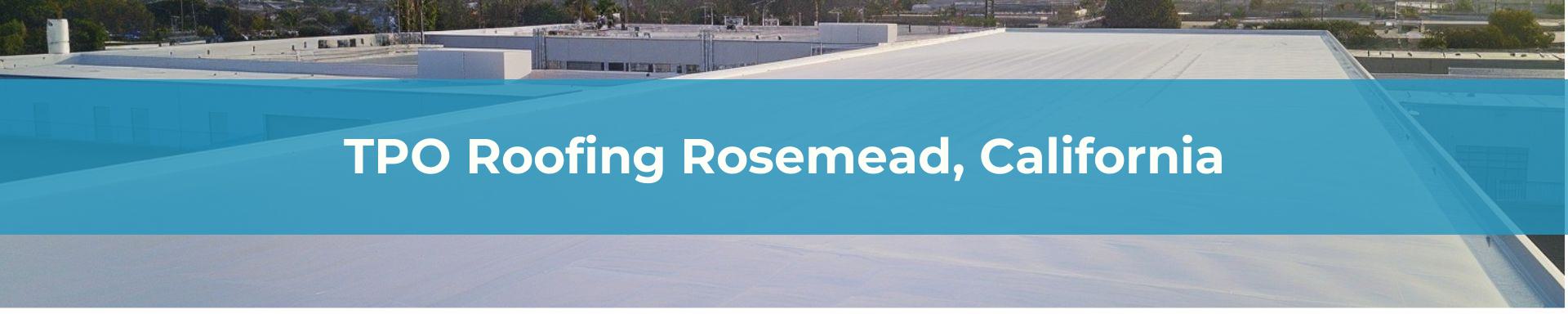
TPO Roofing Los Angeles provides commercial TPO roofing services in Rosemead, California, for flat and low-slope roofs across retail properties, shopping centers, offices, mixed-use buildings, light-industrial premises, and other commercial properties. Rosemead’s non-residential building stock is concentrated around major business corridors such as Garvey Avenue and Valley Boulevard, where established commercial properties sit alongside continuing mixed-use and commercial redevelopment.
TPO Roofing Los Angeles → serves → Rosemead, California.
This property mix creates different TPO roofing requirements. Corridor-based retail, office, and mixed-use buildings can require roofing work to be coordinated around tenants, customers, parking, rooftop mechanical equipment, and restricted staging areas, while light-industrial and larger commercial properties may involve broader membrane fields, service penetrations, drainage systems, loading activity, and operational access requirements. TPO Roofing Los Angeles evaluates membrane and seam condition, moisture extent, attachment, insulation, drainage, roof interfaces, and building use to determine whether an existing TPO roof in Rosemead requires assessment, maintenance, repair, coating, restoration, or replacement.
What TPO Roofing Services Do We Provide In Rosemead, California?
TPO Roofing Los Angeles provides commercial TPO roofing services covering the full roof lifecycle, from identifying the cause and extent of a problem through preventive maintenance, targeted repair, retained-roof improvement, and complete replacement. The appropriate service depends on the condition of the membrane, seams, attachment, insulation, drainage, substrate, and roof interfaces, together with the extent of moisture or deterioration within the existing assembly.
- TPO Roof Leak Detection and Assessment: identifies the source, path, extent, and likely cause of water entry before a roofing scope is selected. Assessment distinguishes an isolated leak from wider membrane, seam, drainage, insulation, attachment, or substrate problems.
- Commercial TPO Roof Maintenance: preserves a serviceable TPO roof through planned inspection, preventive attention, cleaning, drainage management, minor defect correction, and monitoring of seams, flashings, penetrations, perimeters, and other vulnerable details.
- Commercial TPO Roof Repair: corrects defined localised defects where the surrounding roof assembly remains serviceable. Repair may address punctures, open seams, damaged membrane, defective flashings, penetrations, curbs, drains, perimeter details, or limited areas of affected supporting material.
- Commercial TPO Roof Coating: applies a compatible liquid-applied protective system over suitable existing TPO membrane where the roof remains sufficiently dry, stable, and serviceable to retain. Coating renews the exposed surface and can improve resistance to weathering without reconstructing the complete roof assembly.
- Commercial TPO Roof Restoration: retains a serviceable TPO roof while correcting broader deterioration through a combination of repairs, detail reconstruction, reinforcement, moisture correction where appropriate, and compatible surface renewal. Restoration is wider in scope than coating alone but does not require complete replacement of a roof that can still be retained.
- Commercial TPO Roof Replacement: reconstructs the roofing system where deterioration, moisture, attachment failure, substrate problems, incompatibility, or remaining service life makes continued retention impractical. Replacement may involve recovering a suitable existing roof or removing affected materials before installing a new TPO assembly.
Leak detection and assessment → identifies the condition; maintenance → preserves serviceable roofing; repair → corrects localised defects; coating → renews a suitable retained surface; restoration → rehabilitates a broader serviceable roof; replacement → reconstructs an assembly that should no longer be retained.
This service structure allows the roofing scope to follow the actual condition of the TPO system rather than forcing every roof problem into repair or replacement.
Have a question about a TPO roofing project?
What Conditions Affect TPO Roofs in Rosemead?
Commercial TPO roofs in Rosemead are exposed to an inland San Gabriel Valley environment where significant summer heat combines with periodic morning moisture, major freeway and arterial corridors, and a drainage setting connected to the Rio Hondo and Alhambra Wash. These conditions create separate demands on membrane movement, roof-surface condition, and water discharge.
Local conditions → create → thermal loading + surface-moisture exposure + particulate accumulation + drainage demand.
- San Gabriel Valley heat and solar loading: Rosemead experiences substantial inland summer heat, with National Weather Service forecasts placing the area under heat advisories and recent temperatures reaching the mid-90s. Broad exposed commercial roofs receive additional direct solar loading during these periods. High air temperature + solar exposure → increase → TPO membrane temperature and thermal movement, increasing movement demand at seams, attachment zones, equipment curbs, penetrations, flashings, and perimeter details.
- Morning fog and surface moisture: National Weather Service forecasts for Rosemead document periods of overnight cloud followed by morning fog and daytime clearing. Fog + elevated surface moisture → create → damp membrane conditions followed by daytime drying, making surface dryness and cleanliness particularly important when existing TPO is inspected, repaired, adhered, or heat welded.
- Freeway and major-road particulate exposure: Rosemead's circulation network includes the I-10 corridor together with heavily travelled routes such as Rosemead Boulevard, Garvey Avenue, Valley Boulevard, and San Gabriel Boulevard. Commercial properties near these transportation corridors can receive airborne dirt and traffic-related particulates on exposed roof surfaces. Airborne material → accumulates → on membrane, seams, and rooftop interfaces, increasing cleaning and preparation requirements before contaminated or weathered TPO is repaired or heat welded.
- Rio Hondo and Alhambra Wash drainage demand: Rosemead lies within the San Gabriel River watershed, with the Rio Hondo and Alhambra Wash forming part of the surrounding flood-control and drainage network. City planning documents have historically rated regional flood risk as relatively low while identifying a greater potential for localized ponding. Before runoff reaches the wider drainage system, a flat or low-slope TPO roof must first discharge rainfall through its own drains and scuppers. Heavy rainfall + restricted roof drainage → concentrate → water at roof low points, increasing ponding where outlets are obstructed, roof falls are inadequate, or structural deflection has altered the intended drainage path.
These exposures affect the TPO system through separate mechanisms. Solar heating → increases membrane movement; morning moisture → changes roof-surface conditions; transportation corridors → increase particulate exposure; storm rainfall → tests drainage capacity. Their significance depends on the existing membrane condition, seams, attachment, drainage layout, rooftop equipment, penetrations, roof geometry, and the property's proximity to major roads and drainage corridors.
A TPO roof in Rosemead should therefore be evaluated against both the San Gabriel Valley climate and the city's transportation and watershed setting, with particular attention to thermal movement, moisture-sensitive roofing work, membrane cleanliness, and effective drainage.
Have a question about a TPO roofing project?
What Determines the Right TPO Roofing Solution in Rosemead?
The appropriate TPO roofing solution in Rosemead depends on how much of the existing roof remains dry, stable, securely attached, and capable of continued service. Membrane condition, concealed moisture, attachment, drainage, building use, and local exposure determine whether the roof requires limited maintenance or repair, a broader coating or restoration scope, or replacement.
Observed condition + moisture extent + retained attachment + drainage performance + operational constraints + local exposure → determine → how much of the existing TPO assembly can remain in service.
- Membrane and detail condition: isolated seam openings, punctures, flashing defects, or penetration failures may support targeted repair where the surrounding membrane remains stable and serviceable. Localized defects + sound surrounding membrane → support → limited intervention. Distributed deterioration, repeated seam failure, widespread surface damage, or recurring defects across multiple roof areas reduce the value of isolated repairs and can justify restoration or replacement.
- Moisture extent within the assembly: a localized leak does not automatically require broad roof replacement where the entry point can be identified and surrounding insulation, cover board, and attachment remain dry and stable. Localized moisture + identifiable entry point → allow → selective removal and repair. Distributed wet insulation or moisture extending beneath multiple roof areas reduces the amount of assembly that can remain and can shift the scope toward selective replacement or complete reroofing.
- Attachment and substrate stability: the retained roof must provide a reliable base for repair, coating, restoration, or a recover system. Stable substrate + secure membrane attachment → preserve → existing roof as a viable base. Widespread attachment loss, deteriorated decking, recurring membrane movement, or insecure perimeter zones can make localized treatment insufficient because the retained assembly cannot reliably support the proposed intervention.
- Drainage performance: an isolated blocked drain or scupper may require maintenance rather than major roofing work. Persistent ponding caused by inadequate falls, structural deflection, restricted drainage paths, debris accumulation, or recurring outlet problems requires the drainage deficiency to be addressed as part of the roofing scope. Correctable obstruction → support → localized maintenance; recurring drainage deficiency → require → broader corrective work.
- Building use and operational constraints: the roofing solution must account for the activities beneath and around the roof. Retail centers, offices, medical properties, automotive facilities, warehouses, light-industrial buildings, and other occupied commercial properties can have different tolerances for water entry, noise, odors, restricted access, equipment shutdowns, and open-roof work. Higher operational consequence + restricted access → influence → sequencing, protection measures, and viable installation methods, even where two roofs have similar physical defects.
- Rosemead exposure and recurring stress: commercial roofs in Rosemead are exposed to strong San Gabriel Valley heat and solar loading alongside I-10 and major commercial corridors, regional and local seismic movement associated with the Puente Hills Blind Thrust system, and stormwater movement within the Rio Hondo watershed. Heat + solar exposure → increase → membrane temperature and thermal movement; freeway + arterial-road activity → increase → dirt and particulate deposition on exposed TPO surfaces; seismic ground motion → transfers movement → into roof interfaces and termination points; storm rainfall + restricted drainage → increase → ponding at roof low points. Where these stresses have produced only isolated defects, maintenance or repair may remain appropriate. Where they have contributed to recurring seam failure, contaminated repair surfaces, distributed deterioration, concealed moisture, unstable interfaces, or persistent drainage problems, a broader restoration or replacement scope may be required.
The central decision is therefore not simply whether the roof is leaking, but how much of the existing TPO assembly can be retained with confidence. A roof with isolated defects, dry insulation, secure attachment, and effective drainage may justify maintenance or targeted repair. A roof with a serviceable retained assembly but broader surface deterioration may remain suitable for coating or restoration. Distributed deterioration, extensive moisture, unstable attachment, deteriorated decking, or recurring drainage-related failure can make replacement the more appropriate solution.
Limited defect → maintenance or repair; serviceable retained assembly + broader surface deterioration → coating or restoration; widespread moisture, instability, or loss of serviceability → replacement. Leak detection and assessment may be required before any of these scopes can be selected where the source or extent of deterioration has not yet been confirmed.
Have a question about a TPO roofing project?
When Should a Property Owner in Rosemead Contact a TPO Roofing Specialist?
A property owner in Rosemead should contact a TPO roofing specialist when an existing TPO roof shows recurring water entry, seam or membrane deterioration, persistent ponding, drainage defects, suspected wet insulation, attachment concerns, or deterioration at penetrations, edges, and other critical details. Specialist assessment is also appropriate before rooftop equipment is installed or modified, when previous repairs have failed to resolve the underlying problem, or when the roof's remaining serviceability is uncertain. These conditions can indicate problems that extend beyond the visible defect and require the roof assembly, moisture condition, drainage, attachment, and vulnerable details to be evaluated together. The purpose of the assessment is to determine the cause and extent of deterioration, establish whether the existing TPO system can remain in service, and define whether maintenance, targeted repair, coating, restoration, partial replacement, or full replacement is the appropriate next step. Contact TPO Roofing Los Angeles to assess the existing TPO roof and define the required roofing scope for the Rosemead property.