
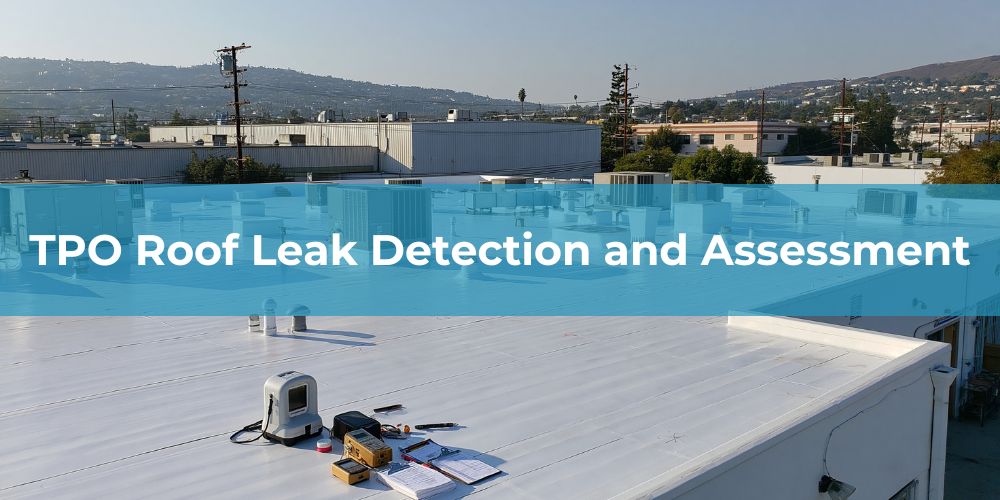
TPO Roofing Los Angeles provides commercial TPO roof leak detection and assessment for warehouses, retail centres, offices, industrial facilities, apartment buildings, and other Los Angeles properties with suspected water entry through flat or low-slope thermoplastic polyolefin roofing systems. TPO roof leak detection is the process of locating the external defect or adjoining interface through which water enters the roofing assembly; roof assessment determines how far moisture has travelled, which components have been affected, and whether the condition requires maintenance, localised repair, restoration, or replacement. Any intrusive investigation or corrective opening of the roofing system is undertaken by a California contractor holding an active C-39 roofing classification. The location of an internal stain does not necessarily identify the point where the roof has failed. Water may enter through an open seam, puncture, penetration, flashing, curb, perimeter detail, drain interface, wall junction, or roof-mounted component before travelling beneath the TPO membrane through insulation joints, fastener paths, deck profiles, or low areas. Accurate assessment therefore follows the complete moisture path from the internal symptom to the probable external entry point rather than applying a patch directly above the visible leak.
A commercial TPO leak assessment may include reviewing the timing and pattern of water entry, examining internal staining and deck conditions, inspecting the field membrane and heat-welded seams, probing suspect laps, checking flashings and terminations, evaluating drains and scuppers, reviewing previous repairs, and investigating adjoining walls or rooftop equipment. Where the roof construction and site conditions permit, moisture surveys, electronic leak-detection methods, controlled water testing, or limited investigative openings may be used to confirm defects that cannot be established through visual inspection alone. Each method answers a different question: surface inspection identifies visible discontinuities, moisture testing maps affected materials, electronic testing locates breaches in compatible membrane assemblies, and intrusive inspection verifies concealed construction. Leak detection must distinguish active entry points from unrelated deterioration. A weathered membrane surface may not be leaking, while a small defect at a penetration or perimeter interface may admit significant water during particular wind or rainfall conditions. Similarly, moisture inside a building may originate from plumbing, condensation, mechanical equipment, wall cladding, or another adjoining component rather than the TPO field membrane. The assessment must therefore confirm the source before roofing work is specified.
The investigation requirements for TPO roof leaks in Los Angeles are determined by the local conditions that control when defects become active and how moisture moves through the assembly:
- Prolonged ultraviolet exposure and elevated rooftop temperatures → weather exposed TPO and reduce flexibility at ageing seams, patches, flashings, and penetrations → small cracks or separations may remain visually difficult to distinguish from general surface ageing → close inspection and targeted testing identify which weathered areas have actually lost waterproofing continuity.
- Repeated daytime heating and overnight cooling → produce movement across welded laps, curbs, wall junctions, perimeter restraints, and roof-mounted equipment → defects can open under thermal stress and partially close as temperatures change → leak assessment must consider movement-sensitive details even when the opening is not fully visible during inspection.
- Santa Ana winds and wind-driven rainfall → direct water against parapets, edge details, penetrations, flashings, and adjoining vertical interfaces → leaks may occur only when wind pressure forces water through a vulnerable connection → the assessment must examine the orientation and height of external details rather than concentrating solely on the horizontal membrane.
- Dust, leaves, ash, and rooftop debris → accumulate around drains, scuppers, gutters, equipment curbs, and low points during extended dry periods → obstructed drainage redirects water toward seams and interfaces that are not normally submerged → leak detection must identify both the opening and the drainage condition that activated it.
- Short periods of concentrated rainfall → rapidly increase water depth around low areas, outlets, penetrations, and previous repairs → defects that remain inactive during light rain admit water when drainage capacity is exceeded or ponding persists → rainfall history and leak timing help isolate the roof zones requiring investigation.
- Frequent access to rooftop HVAC and building-service equipment → exposes membrane routes and mechanical zones to punctures, cuts, displaced protection, loose panels, and damaged flashing details → water may enter through recent service damage remote from the internal symptom → inspection must include access paths and the areas surrounding recently maintained equipment.
- Coastal-to-inland variation across Los Angeles → creates different combinations of heat exposure, airborne contamination, wind, and overnight temperature change → identical internal symptoms may result from different external mechanisms at different properties → the investigation method must be selected according to the individual roof environment and construction.
The initiating condition determines how the leak should be tested. A suspected puncture may be confirmed through close membrane inspection or compatible electronic testing; a wind-driven leak requires examination of edges and vertical interfaces; recurring ponding requires drainage assessment and subsurface moisture mapping; and water appearing after mechanical servicing requires inspection of traffic routes, curbs, supports, and penetrations. Using one detection method for every roof can overlook defects that become active only under a specific combination of movement, water depth, or wind direction. TPO roof leak assessment must also establish the extent of concealed damage. A small membrane opening can allow moisture to spread beyond the visible defect into insulation, cover board, fasteners, attachment components, or structural decking. Surface repair alone may be appropriate where water entry is recent and subsurface materials remain dry and stable; local reconstruction may be required where moisture is contained within a defined area; and broader restoration or replacement may be necessary where wet materials, seam failure, or attachment loss are distributed across multiple roof zones.
TPO Roofing Los Angeles evaluates the leak history, internal evidence, membrane condition, seam integrity, flashing construction, penetrations, drainage behaviour, previous repairs, rooftop activity, moisture distribution, insulation condition, attachment stability, structural deck, and adjoining building interfaces before defining the corrective scope. The completed assessment identifies the probable entry point, the mechanism that activated it, the materials affected beneath the membrane, the repair boundary required to reach sound roofing components, and whether the observed water entry is suitable for targeted TPO repair or indicates a wider roofing-system failure.
How Does TPO Roofing Los Angeles Trace the Source of a Commercial Roof Leak?
TPO Roofing Los Angeles traces a commercial roof leak by linking the internal symptom to the external entry point, the condition that activates the defect, and the route moisture follows through the roofing assembly. The investigation does not assume that a stain, drip, or damaged ceiling sits directly beneath the roof failure. Water can travel beneath the TPO membrane through insulation joints, cover-board interfaces, fastener paths, deck profiles, and low areas before appearing inside the building at a different location. Leak timing provides the first indication of the likely failure mechanism. Water entry limited to wind-driven rain may indicate a defect at a parapet, perimeter, flashing, wall junction, or raised penetration; leakage after prolonged ponding may implicate drains, low points, submerged seams, or previous repairs; and water entry following rooftop servicing may indicate puncture damage or disturbed equipment interfaces. These patterns narrow the investigation before targeted testing or intrusive inspection is used.
The source-tracing process follows seven connected stages:
- Leak history and internal evidence mapping: the timing, duration, frequency, rainfall conditions, wind direction, temperature, recent rooftop activity, drainage events, and previous repairs are compared with active drips, staining, damp finishes, corrosion, wet insulation, deck moisture, and other internal evidence. These observations establish where water emerged and when the defect became active, but they are not treated as proof of the external entry point.
- Roof-zone correlation: the internal evidence is related to the roof construction above, including membrane seams, penetrations, curbs, parapets, drains, scuppers, expansion joints, wall interfaces, deck direction, and low points. This converts the internal symptom into a defined external investigation zone and identifies the concealed routes through which moisture could have travelled.
- External defect and drainage investigation: the relevant field membrane, heat-welded seams, flashings, penetrations, curbs, perimeters, terminations, previous repairs, adjoining construction, drains, scuppers, outlets, and water-flow routes are inspected together. The investigation looks not only for openings, failed welds, punctures, movement, or distorted details, but also for ponding or debris conditions that may have exposed an otherwise intermittent defect to water.
- Alternative-source exclusion: plumbing, condensation, HVAC discharge, equipment leakage, wall cladding, windows, parapet caps, and other adjoining systems are considered where they could reproduce the same internal symptom. Roofing work should not be specified until the TPO assembly or a connected roof interface has been established as the probable source of water entry.
- Targeted testing: seam probing, close membrane examination, moisture surveying, compatible electronic leak detection, controlled water testing, or limited investigative openings are selected according to the unresolved question. The method is chosen to confirm a suspected breach, establish concealed moisture, test a particular interface, or expose hidden construction rather than being applied uniformly across every leak investigation.
- Source and moisture-path confirmation: the investigation determines which suspected location is confirmed, probable, inactive, unrelated, or still unresolved, and establishes how water travelled from the entry point through the roofing assembly. This step distinguishes a surface defect from moisture that has migrated through insulation, cover board, fastener locations, deck profiles, or adjoining structural interfaces.
- Corrective boundary definition: once the entry point and moisture route are established, the work area is extended to sound, dry, stable, and compatible roofing materials. The boundary may remain limited to a seam, puncture, flashing, or penetration, or expand through wet insulation, failed attachment, drainage interfaces, or adjoining construction where concealed damage extends beyond the visible defect.
Los Angeles conditions are incorporated when interpreting this evidence because wind pressure, thermal movement, drainage obstruction, concentrated rainfall, and rooftop activity can activate defects intermittently or away from the internal symptom. These conditions help explain when and why a leak occurs, but they are not treated as evidence of failure without corresponding roof or moisture-path findings. The tracing process is complete only when the investigation explains the relationship between the internal symptom, external entry point, activating condition, moisture route, affected components, and corrective boundary. TPO Roofing Los Angeles then uses that evidence to determine whether the appropriate response is localised seam or membrane repair, flashing or drainage correction, wet-component removal, treatment of an adjoining interface, or a broader assessment of the TPO roofing system.
Have a question about a TPO roofing project?
Which Leak Detection Methods Are Used on Commercial TPO Roofs in Los Angeles?
Commercial TPO roof leak detection uses different investigative methods depending on whether the unresolved question concerns the location of a membrane breach, the condition of a seam or flashing, the extent of concealed moisture, or the construction beneath the visible roof surface. TPO Roofing Los Angeles selects the method according to the suspected failure mechanism, roof construction, accessibility, moisture conditions, and evidence already established during source tracing. No single technique can reliably answer every leak-investigation question.
The principal methods are:
- Visual inspection and seam probing: the TPO field membrane, heat-welded seams, flashings, penetrations, curbs, terminations, perimeters, previous repairs, drains, and adjoining interfaces are examined for punctures, openings, lifting, movement, failed welds, incompatible materials, or distorted details. Seam probing can help identify laps that have lost continuity. This method is most effective where the defect is accessible and physically detectable, but it cannot establish the full extent of concealed moisture beneath an apparently intact surface.
- Moisture surveying: moisture-detection techniques are used to determine whether water has migrated beyond the suspected entry point into insulation, cover board, or other concealed roofing components. The resulting moisture pattern helps distinguish a localised defect from a wider affected area and can guide the position of selective openings or the eventual repair boundary. Moisture surveying identifies areas requiring further investigation, but it does not by itself prove the precise surface opening through which water entered.
- Electronic leak detection: compatible electronic methods may be used to identify discontinuities in TPO membrane assemblies that are difficult to locate through visual inspection alone. The technique can help narrow the position of small punctures, breaches, or other loss of membrane continuity where the roof construction permits reliable testing. Suitability depends on the membrane system, substrate, electrical characteristics, roof condition, and test configuration, so electronic detection is selected only where those conditions support meaningful results.
- Controlled water testing: a defined flashing, curb, wall junction, penetration, drain interface, perimeter detail, or other suspected area may be exposed to water under controlled conditions while the corresponding internal or concealed area is monitored. This can help reproduce an intermittent leak and isolate the interface responsible for water entry. Testing must be limited to a clearly defined zone because uncontrolled water application can spread moisture, activate unrelated defects, or make the original source more difficult to distinguish.
- Selective investigative openings: limited sections of membrane or underlying roofing materials may be opened where concealed moisture, insulation condition, attachment, deck construction, or the route of water movement cannot be verified from the surface. Intrusive inspection can confirm whether apparently local water entry has affected deeper components and establish the boundary between wet, unstable, or damaged materials and sound roofing. Openings are positioned from the preceding evidence so unnecessary disturbance of serviceable roofing is avoided.
- Combined-method investigation: complex leaks frequently require more than one technique because locating the entry point and determining the extent of damage are separate tasks. Visual inspection may identify a probable seam defect, electronic testing may narrow the breach location, moisture surveying may map subsurface spread, and a selective opening may confirm the condition of the insulation or deck. The methods are therefore sequenced to resolve progressively narrower questions rather than applied as a fixed testing package.
Los Angeles conditions influence method selection because some defects become active only under specific combinations of wind pressure, thermal movement, ponding, concentrated rainfall, or rooftop activity. A perimeter leak associated with wind-driven rain may require focused interface investigation, while leakage after prolonged ponding may require drainage assessment together with moisture mapping. The activating condition determines which evidence must be reproduced or verified. The investigation is sufficient only when the selected methods collectively establish the probable entry point, the mechanism that activates it, the route moisture has followed, and the extent of affected roofing materials. TPO Roofing Los Angeles uses those findings to define whether the required response is a localised repair, removal of wet components, reconstruction of a flashing or drainage interface, or a broader assessment of the TPO roofing assembly.
Have a question about a TPO roofing project?
When Should a Los Angeles Business Arrange TPO Roof Leak Detection and Assessment?
A Los Angeles business should arrange TPO roof leak detection and assessment when water entry is recurring, unexplained, difficult to match to a visible roof defect, or triggered only under specific conditions such as wind-driven rain, prolonged ponding, concentrated rainfall, thermal movement, or recent rooftop servicing. Assessment is also appropriate where previous repairs have not stopped the leak, internal staining appears away from the suspected roof defect, or concealed moisture may have spread beyond the visible point of entry. Contact TPO Roofing Los Angeles when the source or extent of a commercial TPO roof leak cannot be established confidently from surface inspection alone. A structured assessment can identify the entry point, activating mechanism, moisture path, affected roofing components, and corrective boundary, then determine whether the appropriate response is maintenance, localised repair, wet-component removal, partial reconstruction, restoration, or complete TPO roof replacement.