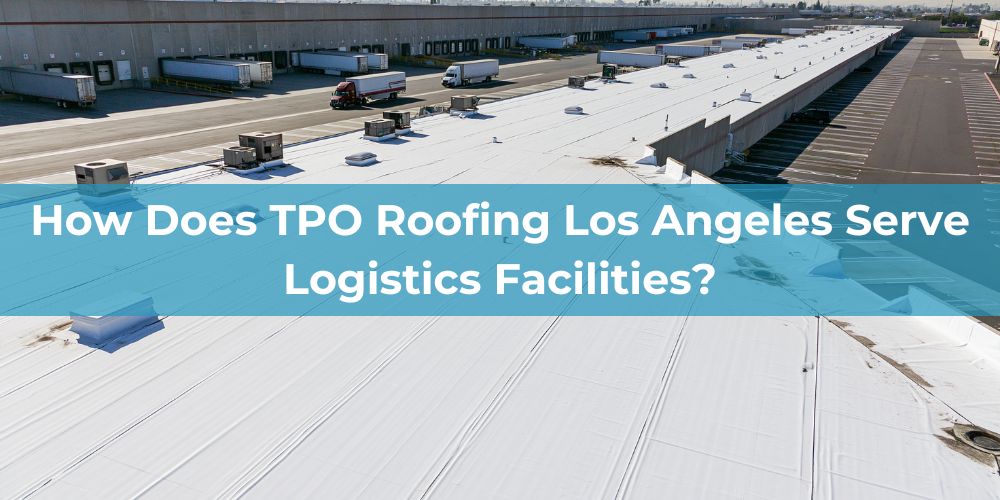
TPO Roofing Los Angeles serves logistics facilities with flat and low-slope TPO roofing systems where roofing decisions must account for both the condition of the roof assembly and the continuous movement of goods through the property. Logistics facilities commonly combine large roof areas with loading docks, vehicle circulation, distribution activity, rooftop equipment, drainage systems, extended operating schedules, and access requirements that can restrict when and where roofing work takes place.
Logistics facility conditions → influence → TPO roofing requirements.
A logistics-facility TPO roof is therefore evaluated in relation to the operational network beneath and around it. Loading activity, dispatch and staging areas, delivery peaks, yard circulation, rooftop services, and access routes can change the consequence of water entry and determine how roofing work must interact with the movement of vehicles, materials, and personnel across the site. TPO Roofing Los Angeles evaluates these operational conditions together with membrane condition, insulation, attachment, drainage, penetrations, and other roof interfaces so the proposed scope reflects both TPO system performance and logistics continuity. The roofing solution must protect the building while remaining compatible with the access, loading, circulation, and distribution functions required to keep the facility operating.
How Do Logistics Operations Affect a TPO Roof?
Logistics operations affect a TPO roof by increasing the duration of building use, the frequency of rooftop servicing, the intensity of loading and distribution activity, and the operational consequence of water entry or restricted access. These conditions can change how frequently roof areas are disturbed, how building movement is transmitted through interfaces, and how much disruption even a limited roofing defect can cause.
Logistics activity → changes → roof exposure + service demand + consequence of disruption.
- Extended operating hours: facilities operating across long shifts, overnight periods, or continuous distribution schedules provide fewer low-activity windows in which roofing inspections, servicing, or disruptive work can occur without affecting building use.
- Frequent mechanical and rooftop servicing: HVAC units, ventilation equipment, controls, communications systems, and other rooftop services may require regular access. Repeated foot traffic, tools, temporary equipment, and maintenance activity increase mechanical exposure along service routes and around curbs, penetrations, and access points.
- Loading and distribution intensity: high levels of inbound, outbound, sorting, staging, and dispatch activity increase the operational importance of the roof areas above loading bays and handling zones. Water entry or temporary work restrictions in these locations can affect the movement of goods through the facility.
- Vibration and building movement: loading equipment, dock activity, mechanical systems, and structural movement can introduce repeated movement into the building. Where that movement reaches rooftop curbs, supports, penetrations, or adjoining details, the TPO system must continue to accommodate it without losing waterproofing continuity.
- Internal sensitivity to water entry: leaks above dispatch lanes, sorting areas, conveyors, parcel-handling zones, staging areas, electrical systems, or stored goods can interrupt logistics activity even where the roof defect itself is limited in size.
- Restricted access and temporary roof openings: logistics facilities depend on continuous circulation through yards, docks, internal handling routes, and service areas. Roofing work that restricts those areas or requires temporary roof openings can therefore create operational disruption beyond the immediate roof work zone.
These conditions interact.
Extended operating hours → reduce → available work windows; frequent servicing → increases → membrane exposure; distribution intensity and internal assets → increase → the consequence of water entry; circulation requirements → increase → the consequence of access restrictions.
A TPO roof on a logistics facility must therefore be evaluated not only by the physical severity of a defect, but by how that defect interacts with the facility’s operating rhythm. A localised roof problem can carry greater significance where it affects heavily serviced roof areas, high-throughput zones, or parts of the building that cannot be easily taken out of operation.
Have a question about a TPO roofing project?
Which Parts of a Logistics Facility Create Critical TPO Interfaces?
Critical TPO interfaces on a logistics facility occur where building systems, drainage components, access points, and adjoining roof sections interrupt or terminate the waterproofing layer. Their significance is increased where those interfaces serve or sit above loading, sorting, dispatch, staging, or circulation areas that cannot tolerate repeated water entry or prolonged disruption.
Logistics facility systems → intersect with → TPO waterproofing boundary.
- HVAC and ventilation serving loading or sorting areas: rooftop units, intake systems, and ventilation equipment connect through curbs, ducts, supports, and service penetrations. Where these systems serve high-use internal zones, deterioration around the interface can affect both waterproofing continuity and the operation of the space below.
- Roof drains and scuppers: drainage outlets collect and discharge water from large roof areas. Their importance increases where blocked, damaged, or poorly integrated outlets allow water to accumulate above loading bays, dispatch areas, or other parts of the facility where leakage would interrupt goods movement.
- Skylights and smoke vents: these openings create repeated curb transitions through the TPO field. Where positioned above sorting, handling, or storage areas, defects around the curb can expose high-use operational zones directly beneath the roof opening.
- Equipment curbs: mechanical and service equipment is commonly supported on raised curbs that require the TPO membrane to transition from horizontal roof field to vertical surfaces. These interfaces may also be subject to repeated maintenance access, equipment replacement, and movement over the life of the facility.
- Service penetrations: conduits, pipes, vents, controls, and communications services create localised interruptions in the membrane. Their operational importance depends not only on the penetration itself, but on the systems they support and the activity occurring beneath the surrounding roof area.
- Roof hatches and access points: hatches, ladders, and designated access zones concentrate foot traffic where personnel enter and leave the roof. These locations combine membrane transition with repeated servicing activity and can become critical where they provide the main access route to rooftop systems serving active logistics areas.
- Parapets and perimeter edges: the TPO system terminates at walls, edge metal, and perimeter conditions that must maintain both waterproofing continuity and secure attachment. Their importance increases where the roof edge adjoins loading docks, canopies, vehicle routes, or other heavily used external areas.
- Canopy and adjoining roof transitions: where dock canopies, lower roofs, entrance structures, or other adjoining sections connect with the main roof, changes in level and construction can create complex termination and drainage relationships. These transitions are particularly important where they sit directly above loading positions, pedestrian routes, or staging areas.
The criticality of these interfaces depends on both how they interrupt the TPO system and what operates around them.
Roof interfaces → create → localised waterproofing complexity; high-use logistics zones → increase → the operational consequence of interface failure.
A small defect around a drain, curb, penetration, hatch, perimeter, or canopy transition can therefore have disproportionate significance where it affects a loading bay, sorting line, dispatch route, service access point, or other part of the facility that must remain continuously usable.
How Are TPO Roofing Works Coordinated Around an Operating Logistics Facility?
TPO roofing work on an operating logistics facility must be coordinated around the continuous movement of vehicles, freight, personnel, and materials through the site. Loading docks, yard circulation, delivery peaks, handling schedules, lifting operations, roof access, and internal protection requirements can all determine where roofing activity is permitted, when materials can be moved, and how much roof can be opened at one time.
Logistics flow → constrains → access + staging + sequencing + protection.
- Loading dock availability: active dock positions may need to remain accessible for trailers, goods handling, and dispatch activity. Roofing work, lifting zones, debris removal, or temporary exclusion areas can therefore be phased so they do not unnecessarily remove critical loading capacity.
- Trailer and HGV circulation: articulated vehicles require wide turning areas, reversing space, and predictable access routes around the building. Cranes, delivery vehicles, skips, barriers, or material storage must not obstruct the circulation paths needed to keep freight moving through the site.
- Yard access: external yards often support trailer staging, vehicle queuing, loading, parking, and material handling simultaneously. The location of roofing equipment and ground-level staging must therefore fit within the areas that can be temporarily occupied without disrupting essential yard functions.
- Inbound and outbound delivery peaks: periods of concentrated receiving or dispatch activity can limit when roofing materials arrive, when cranes or hoists operate, and when elevations beside loading areas are available. Roofing logistics may need to shift into lower-throughput periods rather than compete with peak freight movement.
- Parcel or freight handling schedules: sorting, cross-docking, staging, and dispatch operations can create time-sensitive internal work cycles beneath specific roof areas. Roofing above these zones may need to be sequenced around periods when temporary protection, noise, debris control, or restricted access can be accommodated.
- Staff and vehicle segregation: roofing personnel, delivery drivers, warehouse staff, forklifts, HGVs, and lifting equipment may share adjacent areas of the site. Access routes and exclusion zones must therefore preserve separation between contractor activity and normal logistics traffic.
- Crane and lifting locations: membrane, insulation, cover boards, equipment, and removed materials require controlled lifting between ground and roof level. The selected lifting position must provide safe roof access without occupying essential dock doors, trailer routes, emergency access, or high-use yard areas for longer than necessary.
- Roof access: ladders, hatches, stairs, and designated entry points determine how personnel reach active roof zones. Access arrangements should connect efficiently with the work area while avoiding conflict with loading elevations, vehicle circulation, or operationally sensitive ground-level areas.
- Protection of sorting, dispatch, and staging areas: active roof sections above high-throughput internal zones may require temporary protection against debris, dust, or accidental water entry. The ability to protect the area below can determine whether a roof section can be opened while logistics activity continues.
- Daily weatherproofing limits: each active roof area must remain small enough to be completed, temporarily secured, or tied into finished TPO roofing before rainfall, significant wind, the end of the permitted work window, or a return to full operational use beneath the area.
These constraints are connected by the movement of goods through the site.
Dock demand and vehicle circulation → control → available staging space; delivery and handling peaks → define → workable time windows; lifting and roof access → determine → material routes; internal operations and weatherproofing capacity → limit → active roof-area size.
TPO roofing on a logistics facility must therefore be sequenced around throughput rather than occupancy alone. The work programme should allow the roof assembly to progress without unnecessarily reducing dock capacity, blocking vehicle circulation, interrupting freight handling, or leaving active roofing areas exposed beyond the period in which they can be safely controlled.
What Determines the TPO Roofing Scope for a Logistics Facility?
The TPO roofing scope for a logistics facility is determined by the condition of the roof assembly, the extent of concealed moisture, attachment reliability, drainage performance, the condition of critical interfaces, the intensity of logistics activity, and the operational constraints that affect where and when roofing work can proceed.
Roof condition + moisture extent + attachment + drainage + interface condition + logistics intensity + operational constraints → determine → appropriate TPO roofing scope.
- Roof condition: establishes whether deterioration is confined to individual membrane defects or repeated across wider areas that affect seams, flashings, substrate, or adjoining details. The significance of a defect increases where it sits above a loading, sorting, dispatch, or other high-use operational zone.
- Moisture extent: determines whether water intrusion remains close to the visible leak location or has migrated through insulation, cover boards, or adjoining roof layers. The work boundary should reflect the actual moisture distribution rather than the internal symptom alone.
- Attachment condition: establishes whether the membrane and supporting roof build-up remain securely connected to the structure or whether weakness extends across a larger section of the roof assembly.
- Drainage performance: determines whether water can leave the roof effectively or whether low points, restricted outlets, deflection, or drainage geometry are concentrating water above large loading, handling, storage, or circulation areas.
- Interface condition: establishes which drains, curbs, skylights, penetrations, hatches, perimeters, canopies, or adjoining roof transitions must be included within the work boundary because their condition affects waterproofing continuity.
- Logistics intensity: determines the operational consequence of roofing activity in each area. Roof zones above heavily used docks, dispatch areas, sorting operations, or high-throughput routes may require tighter sequencing and shorter periods of temporary exposure than less critical parts of the facility.
- Operational constraints: determine whether the required work can be divided into phases without obstructing vehicle circulation, reducing essential dock capacity, conflicting with lifting operations, or interrupting freight movement. Available operational windows can therefore define the practical size and timing of each roofing phase.
Scope selection must therefore resolve two questions: how far the roofing problem extends and how much of that area can be worked on without disrupting logistics flow. A technically localised defect may still require carefully phased work where access, lifting, dock availability, or vehicle circulation restrict the practical work zone, while concealed moisture or repeated deterioration can require a wider scope than the visible symptom suggests. The resulting scope may involve assessment, maintenance, repair, coating, restoration, partial reconstruction, or replacement, depending on which parts of the TPO assembly remain serviceable and how the required work can be coordinated around the operating logistics facility.
When Should a Logistics Facility Owner Speak to a TPO Roofing Specialist?
A logistics facility owner should speak to a TPO roofing specialist when an existing TPO roof has recurring leaks above loading, sorting, dispatch, or storage areas, ponding or drainage problems, suspected wet insulation, widespread membrane ageing, or seam deterioration that may affect a larger section of the roof. Specialist input is also appropriate where deterioration is concentrated around drains, skylights, equipment curbs, service penetrations, or other roof interfaces, or before planned rooftop equipment changes introduce new loads, penetrations, supports, or alterations to the existing waterproofing system. Early assessment is particularly important where roofing work will require cranes, lifting zones, temporary yard occupation, restricted dock access, or sequencing around continuous deliveries and freight movement. Contact TPO Roofing Los Angeles to review the roof condition, planned alterations, or TPO roofing work that must be coordinated around an operating logistics facility.