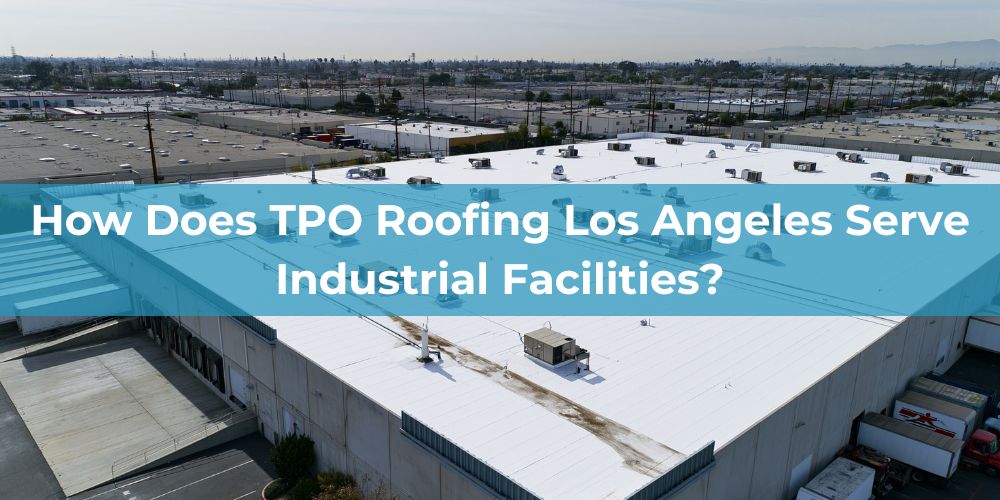
TPO Roofing Los Angeles serves industrial facilities with flat and low-slope TPO roofing systems where roofing decisions must account for both the condition of the roof assembly and the processes operating beneath and through it. Industrial roof requirements can be influenced by process equipment, exhaust systems, airborne contaminants, concentrated service zones, penetrations, vibration, maintenance traffic, drainage, and the operational sensitivity of production areas below.
Industrial facility conditions → influence → TPO roofing requirements.
An industrial TPO roof is therefore evaluated as part of a working facility rather than as an isolated waterproofing surface. Manufacturing activity, ventilation systems, process pipework, rooftop machinery, service access, and material handling can change the exposure of the membrane, increase the number of roof interfaces, and affect how deterioration or water entry should be interpreted. TPO Roofing Los Angeles evaluates these facility conditions together with membrane condition, attachment, insulation, drainage, and supporting roof components so the proposed roofing scope reflects both system performance and industrial operating requirements. The roof must remain compatible with the equipment, services, access routes, and production functions that interact with the TPO assembly.
How Do Industrial Operations Affect a TPO Roof?
Industrial operations affect a TPO roof by changing the contaminants, heat, movement, service traffic, and equipment interfaces to which the membrane is exposed. These conditions can increase localised wear, alter material compatibility, concentrate maintenance activity, and raise the operational consequence of water entering the facility below.
Industrial activity → changes → membrane exposure + service demand + consequence of failure.
- Process exhaust: exhaust outlets can discharge heat, vapour, particulates, or process residues onto nearby membrane areas. The type, concentration, and direction of discharge influence how severely the surrounding TPO surface and adjoining details are exposed.
- Grease, oils, dust, chemicals, and airborne residues: deposited contaminants can change membrane surface condition and affect the suitability of welding, bonding, sealing, or coating in exposed areas. Contamination must therefore be considered separately from ordinary membrane ageing.
- Maintenance access: industrial equipment often requires repeated inspection, servicing, and replacement. Concentrated foot traffic, tools, temporary equipment, and material movement increase mechanical exposure along access routes and around frequently serviced components.
- Concentrated equipment zones: clusters of HVAC units, process equipment, ducts, pipes, curbs, and supports increase the density of waterproofing interfaces within a limited roof area. More interfaces create more locations where movement, service activity, or alteration can affect membrane continuity.
- Vibration and movement: operating machinery, structural movement, thermal cycling, and equipment vibration can impose repeated movement on supports, curbs, penetrations, and adjoining roof details. These effects are most significant where rigid building components intersect with flexible membrane assemblies.
- Heat-generating processes: elevated temperatures from exhaust systems, production equipment, or process activity can create localised thermal exposure that differs from the general solar heating experienced across the roof field.
- Production sensitivity to water entry: water intrusion above machinery, electrical equipment, production lines, stored materials, or controlled process areas can interrupt operations or damage high-value assets even where the roof defect itself is limited in size.
These exposures often occur together. Process activity → produces → heat and contaminants; equipment density → increases → service interfaces and access demand; machinery and production areas → increase → the consequence of waterproofing failure.
An industrial TPO roof must therefore be evaluated according to both the physical condition of the membrane and the operating environment acting upon it. The same visible defect can carry a different level of significance where it is exposed to contamination, repeated servicing, movement, concentrated equipment, or sensitive production areas.
Have a question about a TPO roofing project?
Which Industrial Systems Interact With the TPO Roof?
Industrial TPO roofs often contain denser and more frequently altered service interfaces than standard commercial roofs because process, ventilation, mechanical, electrical, and communications systems must pass through, terminate at, or be supported above the waterproofing layer. Each interface creates a location where the TPO membrane must remain continuous while accommodating equipment operation, servicing, movement, or future modification.
Industrial systems → intersect with → TPO waterproofing boundary.
- Exhaust stacks and vents: process exhaust penetrations carry air, vapour, heat, or residues through the roof assembly. Their flashings must maintain membrane continuity while remaining compatible with the temperature, movement, and discharge conditions created by the system.
- Process pipework: pipes carrying water, gases, chemicals, steam, or process media may cross the roof or pass through it at multiple locations. Supports, penetrations, and changes in routing create repeated interfaces that can be affected when pipework is altered, serviced, or expanded.
- HVAC and make-up air units: large mechanical units connect the roof to ventilation and environmental-control systems serving the facility below. Curbs, ducts, condensate routes, service clearances, and access paths around these units must remain coordinated with the surrounding TPO waterproofing.
- Equipment curbs and structural supports: machinery, frames, platforms, and rooftop equipment transfer loads through curbs or supports connected to the building structure. These details create concentrated transitions where structural movement, equipment vibration, and membrane termination must be accommodated together.
- Ducts and service penetrations: ducts, conduits, sleeves, vents, and other services interrupt the field membrane wherever building systems pass through the roof. Industrial facilities can contain numerous closely spaced penetrations, increasing the amount of detailing required within relatively small roof areas.
- Cable trays and communications equipment: electrical, control, data, and communications systems often require trays, mounts, supports, and access routes across the roof. Their installation or later modification can introduce new loading points, penetrations, or traffic paths that must remain separated from vulnerable membrane areas.
- Drains, scuppers, walls, and perimeters: these elements connect the TPO system to the building's drainage and enclosure boundaries. Their function becomes particularly important where dense equipment layouts, supports, or later alterations restrict drainage paths or complicate access to roof edges and outlets.
The distinguishing feature of many industrial roofs is not simply the number of rooftop components, but the frequency with which those components are serviced, replaced, extended, or reconfigured.
Greater interface density + repeated system alteration → increases → the number of locations where industrial activity can affect waterproofing continuity.
Industrial TPO performance therefore depends on maintaining a coherent waterproofing boundary through a roof that may continue to change throughout the operating life of the facility. New equipment, rerouted pipework, replacement units, added supports, or modified services must remain integrated with the existing TPO system rather than becoming independent interruptions in it.
How Are TPO Roofing Works Coordinated Around an Operating Industrial Facility?
TPO roofing work on an operating industrial facility must be coordinated around production activity, process systems, controlled areas, internal assets, contractor movement, and the requirement to keep the roof weatherproof while work progresses. These constraints can determine when roofing work is permitted, which areas can be opened, how materials reach the roof, and how completed and unfinished sections are protected.
Industrial operation → constrains → access + work area + sequencing + protection.
- Production schedules: roofing activity may need to avoid periods when noise, vibration, debris, temporary exposure, or restricted access could interfere with manufacturing, processing, loading, or other critical operations.
- Shutdown windows: some roof areas can only be accessed safely when associated equipment, production lines, exhaust systems, or process zones are temporarily taken out of service. The available shutdown period can therefore determine the size and sequence of the roofing work completed in each phase.
- Restricted process areas: controlled zones, hazardous operations, hygiene-sensitive areas, or limited-access sections can restrict personnel routes, roof-entry points, staging locations, and the timing of work above specific parts of the facility.
- Machinery and inventory beneath the roof: production equipment, electrical systems, stored materials, finished goods, and process infrastructure increase the protection required beneath active roofing areas and reduce tolerance for temporary water entry, debris, or uncontrolled roof openings.
- Operational exhaust and ventilation systems: exhaust stacks, extraction systems, make-up air units, and ventilation equipment may need to remain operational throughout the project. Roofing around these systems must therefore be sequenced without blocking air movement, restricting service access, or leaving adjacent membrane work incomplete.
- Contractor access: industrial sites often operate permit, induction, escort, segregation, or restricted-access procedures for external contractors. These controls can affect working hours, roof access points, emergency routes, and the number of personnel permitted within an active area.
- Lifting and material movement: membrane, insulation, cover boards, equipment, and removed materials must move through a facility that may already contain vehicle routes, loading operations, cranes, production traffic, or restricted ground zones. Lifting locations and delivery windows can therefore determine which roof sections can be supplied and progressed efficiently.
- Contamination control: dust, debris, removed roofing materials, adhesives, and equipment movement may need to be isolated from production areas, sensitive processes, stored products, or clean environments. The required containment measures can limit the extent of simultaneous roofing activity.
- Weatherproofing limits: each active section must remain small enough to be completed, temporarily secured, or tied into finished TPO roofing before rainfall, significant wind, shutdown of the site, or the end of the permitted work period. Industrial sequencing therefore depends on both operational access and the amount of roof that can be made watertight within the available window.
These constraints are interdependent.
Production schedules and shutdowns → define → available work periods; process controls and internal assets → determine → protection requirements; access and lifting restrictions → control → logistics and staging; weatherproofing capacity → limits → active roof area.
TPO roofing work on an industrial facility must therefore be planned around both the roofing assembly and the operating process beneath it. The work sequence must allow the roof to progress without unnecessarily interrupting production, compromising process systems, exposing machinery or inventory, or leaving unfinished waterproofing beyond the period in which it can be safely controlled.
What Determines the TPO Roofing Scope for an Industrial Facility?
The TPO roofing scope for an industrial facility is determined by the condition of the roof assembly, the extent of concealed moisture, the presence of contamination, attachment reliability, drainage performance, the condition of industrial roof interfaces, and the operational constraints that affect how the facility can remain functional during the work.
Roof condition + moisture extent + contamination + attachment + drainage + industrial interfaces + operational constraints → determine → appropriate TPO roofing scope.
- Roof condition: establishes whether deterioration is localised, distributed, or systemic across the membrane, seams, flashings, substrate, and adjoining roof details.
- Moisture extent: determines whether water intrusion is confined to a limited area or has spread into insulation, cover boards, attachment components, or the structural deck.
- Contamination: establishes whether grease, oils, chemicals, dust, process residues, or other deposits have affected membrane condition or the compatibility of retained surfaces with welding, bonding, sealing, or coating.
- Attachment condition: determines whether the membrane and supporting roof build-up remain securely connected to the structure and capable of transferring loads through the existing assembly.
- Drainage performance: establishes whether roof geometry, outlets, low points, equipment layouts, or later alterations allow water to leave the roof without persistent uncontrolled accumulation.
- Industrial interfaces: determine which exhaust systems, process penetrations, pipework, curbs, supports, ducts, and service zones must remain waterproof, accessible, operational, or incorporated into the work boundary.
- Operational constraints: determine when and where roofing work can proceed without disrupting production, compromising controlled processes, exposing machinery or inventory, or interfering with systems that must remain operational.
Industrial scope selection therefore depends on more than the physical extent of roof deterioration. Contamination influences material suitability; process interfaces define waterproofing dependencies; operational continuity defines when and how the required work can be completed. These factors can change the appropriate work boundary even where two roof areas show similar visible deterioration. The resulting scope may involve assessment, maintenance, repair, coating, restoration, partial reconstruction, or replacement. The appropriate response follows from the combined condition of the TPO assembly and the industrial environment in which that assembly must continue to perform.
When Should an Industrial Facility Owner Speak to a TPO Roofing Specialist?
An industrial facility owner should speak to a TPO roofing specialist when an existing TPO roof has recurring water entry, suspected or confirmed membrane contamination, drainage problems, an unknown moisture condition, or ageing membrane around heavily serviced equipment and process zones. Specialist input is also appropriate before process equipment is installed, removed, or altered; when new penetrations, curbs, pipework, or structural supports will affect the roof; or when a planned shutdown creates an opportunity to complete roofing work that cannot be carried out safely during normal production. Where roofing work must proceed while critical operations remain active, early assessment is particularly important so the work boundary, access, protection, sequencing, and weatherproofing requirements can be coordinated around the facility. Contact TPO Roofing Los Angeles to review the existing roof condition, planned industrial changes, or TPO roofing work that must be completed without unnecessary interruption to production.