
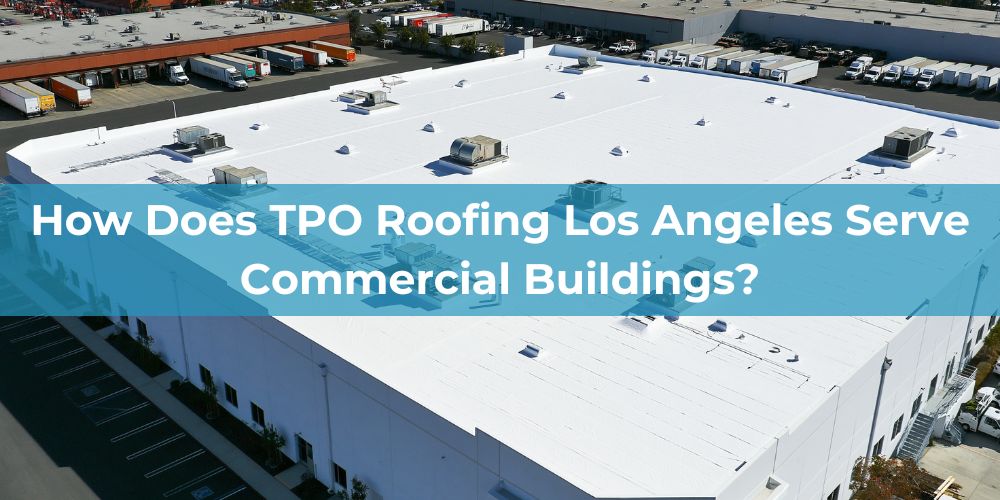
TPO Roofing Los Angeles serves commercial buildings with flat and low-slope TPO roofing systems where the correct roofing scope depends on both the condition of the roof assembly and the way the property operates. Commercial roofing decisions must account for membrane condition, attachment, insulation, drainage, rooftop equipment, penetrations, access routes, occupancy, and the operational requirements of the building beneath the roof. A commercial roof is therefore not assessed as an isolated waterproofing surface. Building use can change equipment density, service traffic, contamination exposure, access frequency, internal sensitivity to leaks, and the consequences of opening or disturbing the roof during work. These conditions influence how the TPO system must be investigated, protected, sequenced, and integrated with the building.
Commercial building conditions → influence → TPO roofing requirements.
TPO Roofing Los Angeles evaluates the roof assembly together with the building conditions that affect it so the proposed work reflects both roofing performance and operational constraints. The resulting scope must protect the waterproofing system while remaining compatible with drainage, rooftop equipment, occupied areas, access needs, and other building functions that interact with the roof.
How Does Commercial Building Use Affect a TPO Roof?
Commercial building use affects a TPO roof by changing how frequently the roof is accessed, how much equipment and service infrastructure it supports, what contaminants reach the membrane, how many penetrations and interfaces must remain watertight, and how disruptive a leak would be to the building below.
Building use → changes → roof exposure + interface demand + consequence of failure.
- Rooftop traffic: frequent access by maintenance teams, contractors, and equipment technicians increases wear around walkways, service routes, curbs, penetrations, and other repeatedly used areas.
- Equipment density: additional HVAC units, ducts, pipework, supports, vents, and rooftop systems increase the number of interfaces that must remain integrated with the TPO waterproofing layer.
- Contamination exposure: exhaust residue, grease, dust, chemicals, and process by-products can alter membrane condition and affect the reliability of bonding, sealing, welding, or coating around exposed areas.
- Penetration frequency: buildings with more services passing through the roof create more points where the field membrane must transition around pipes, curbs, supports, drains, and other interruptions.
- Access frequency: roofs that require regular servicing are exposed to more repeated foot traffic, temporary equipment, tools, and material movement than roofs with limited operational access.
- Internal sensitivity to water entry: occupied spaces, stock, machinery, finishes, electrical systems, or tenant areas can increase the practical consequence of even a limited roof defect.
These conditions change the way the same visible TPO defect should be interpreted. A small puncture in a lightly accessed roof area may remain isolated, while a similar defect beside heavily serviced equipment, contaminated membrane, or sensitive occupied space can carry a different operational risk. Commercial building use therefore influences the level of roof exposure, the number and complexity of waterproofing interfaces, and the consequence of failure without changing the underlying function of the TPO system itself.
Have a question about a TPO roofing project?
Which Parts of a Commercial Building Interact With the TPO Roof?
A commercial TPO roof connects with multiple building systems that interrupt, terminate, drain, support, or require access across the waterproofing layer. These interfaces must remain integrated with the membrane because movement, alteration, deterioration, or service activity at one building component can affect the surrounding TPO assembly.
Building systems → intersect with → the TPO waterproofing boundary.
- HVAC units and equipment curbs: rooftop equipment is commonly supported above the membrane on curbs or structural supports. These locations create horizontal-to-vertical transitions where flashing must maintain waterproofing while accommodating equipment access and movement.
- Penetrations and supports: pipes, vents, conduits, ducts, structural supports, and other services pass through or connect with the roof assembly. Each penetration creates a point where the field membrane must transition around another component without leaving an uncontrolled water-entry path.
- Parapets and walls: roof-to-wall junctions terminate or redirect the membrane at vertical surfaces. Waterproofing continuity depends on the relationship between the field membrane, vertical flashing, termination details, and adjoining wall construction.
- Drains and scuppers: drainage components connect the roof surface to the building's water-disposal system. Their position, integration with the membrane, and ability to remain unobstructed influence both waterproofing continuity and how long water remains on the roof.
- Roof access and walkways: hatches, ladders, service routes, and designated walkways concentrate traffic across specific parts of the roof. These areas influence membrane exposure and must allow access to equipment without repeatedly loading or damaging unprotected TPO surfaces.
- Perimeter conditions: roof edges, parapet boundaries, edge metal, and adjoining elevations define where the TPO system terminates. These locations combine waterproofing termination with attachment and wind exposure, making their continuity important to the stability of the roof assembly.
These interfaces are not independent of the field membrane. Equipment and penetrations → interrupt → the roof surface; walls and perimeters → terminate → the membrane; drains and scuppers → discharge → roof water; access routes → expose → the membrane to operational traffic.
Commercial TPO performance therefore depends on maintaining waterproofing continuity wherever the roof connects with the building it protects. An intact field membrane cannot provide complete protection if water can enter through an adjoining curb, penetration, wall transition, drainage connection, or perimeter detail.
How Are TPO Roofing Works Coordinated Around an Operating Commercial Building?
TPO roofing work on an operating commercial building must be coordinated around the activities beneath and around the roof. Occupancy, inventory, tenant access, rooftop equipment, deliveries, other contractors, internal protection requirements, and weather exposure can all limit where work takes place, how much roof can be opened, and when each area can progress.
Building operation → constrains → access + work area + sequencing + protection.
- Occupancy: occupied areas beneath the roof can limit the size and timing of open work zones because removal, debris, vibration, noise, and temporary exposure must be controlled around people and internal operations.
- Inventory and sensitive contents: stock, machinery, finishes, electrical systems, and other water-sensitive assets increase the protection required beneath planned roof openings and reduce tolerance for unfinished or temporarily weatherproofed areas.
- Tenants and customer areas: entrances, parking, loading areas, shared access routes, and occupied units can restrict lifting, deliveries, debris removal, and personnel movement. Roofing logistics must therefore remain separated from normal property circulation.
- Rooftop equipment access: HVAC units, exhaust systems, communications equipment, and other services may need to remain accessible during roofing work. Areas around curbs, penetrations, supports, and service routes must be sequenced so equipment operation and maintenance do not conflict with unfinished membrane work.
- Deliveries and material movement: roofing materials, equipment, removed debris, and lifting operations require controlled routes between ground-level staging areas and the active roof zone. Delivery timing and storage locations can determine which roof sections are practical to open at the same time.
- Other rooftop contractors: mechanical, electrical, solar, communications, and maintenance contractors can introduce traffic, tools, materials, or new penetrations into the work area. Responsibility boundaries and access routes must therefore be defined so completed or unfinished TPO roofing is not damaged by unrelated activity.
- Internal protection: work above occupied or sensitive areas may require temporary protection against debris, dust, or accidental water entry. Roofing sections should not be opened where the necessary protection beneath them cannot remain in place for the duration of the work.
- Weatherproofing capacity: the active work area must remain small enough to be reconstructed, secured, or temporarily tied into completed roofing before rainfall, significant wind, or an unattended period. Building operations therefore affect not only when work begins, but how much roof can safely remain active at one time.
These constraints interact. Occupancy and assets → determine → protection requirements; tenants and deliveries → control → access and staging; rooftop equipment and contractors → create → sequencing dependencies; weatherproofing capacity → limits → active work-area size.
Commercial TPO roofing work is therefore coordinated as both a roofing operation and a building-protection process. The sequence must allow the roof assembly to progress without exposing occupants, contents, equipment, access routes, or unfinished waterproofing to avoidable risk.
What Determines the TPO Roofing Scope for a Commercial Building?
The TPO roofing scope for a commercial building is determined by the condition of the roof assembly, the extent of concealed moisture, the reliability of attachment and drainage, the way the building is used, the condition of rooftop equipment interfaces, and the operational constraints that affect how work can be carried out.
Roof condition + moisture extent + attachment + drainage + building use + equipment interfaces + operational constraints → determine → appropriate TPO roofing scope.
- Roof condition: establishes whether deterioration is isolated, distributed, or systemic across the membrane, seams, flashings, substrate, and adjoining details.
- Moisture extent: determines whether water intrusion is confined to a local area or has spread into insulation, cover boards, attachment components, or the supporting deck.
- Attachment condition: establishes whether the membrane and supporting roof build-up remain securely connected to the structure or whether attachment weakness affects a wider section of the assembly.
- Drainage performance: determines whether water can leave the roof effectively or whether low points, restricted outlets, structural deflection, or drainage geometry are contributing to recurring exposure.
- Building use: changes the level of rooftop traffic, contamination, equipment density, penetration frequency, internal sensitivity to leaks, and practical consequence of roofing failure.
- Equipment interfaces: determine whether curbs, penetrations, supports, ducts, pipes, and service zones can remain integrated with the TPO waterproofing boundary.
- Operational constraints: establish how occupancy, tenants, inventory, access, deliveries, other contractors, internal protection, and weatherproofing capacity affect the size and sequence of the work area.
The roofing scope is therefore based on both what has failed and what must remain functional around it. A technically suitable roofing response can still require a different work boundary or sequence where building operations, equipment access, or protection requirements limit how the roof can be opened and completed. The resulting scope may involve assessment, maintenance, repair, coating, restoration, partial reconstruction, or replacement, but those service decisions follow from the combined condition of the roof assembly and the commercial building it protects.
When Should a Commercial Property Owner Speak to a TPO Roofing Specialist?
A commercial property owner should speak to a TPO roofing specialist when an existing TPO roof shows recurring water entry, uncertain deterioration, drainage problems, or changes that may affect the waterproofing system. Specialist input is also appropriate before rooftop equipment, curbs, penetrations, supports, or other building services are installed, removed, or modified. Assessment is particularly important where the roof condition is unclear or roofing work must be coordinated around occupied areas, tenants, inventory, equipment access, deliveries, or other operating constraints. Contact TPO Roofing Los Angeles to review the existing roof condition, planned rooftop changes, or commercial TPO work that requires coordination with the building in use.